I had the pleasure of sitting down with Lauri Stallings and Nicole Johnson of gloATL and record another episode of ARTSpeak on AM1690 WMLB. The three of us discussed gloATL's world premier of Chapter III: This Is a World.
You can hear it today on WMLB AM1690 during your drive home or also by visiting BURNAWAY.
Tuesday, April 26, 2011


Tuesday, April 12, 2011
new post at BURNAWAY
I have a review of Craig Dongoski's show Attack/Decay/Sustain/Release (Whitespace, 814 Edgewood) over at BURNAWAY.
It's a great show and I enjoyed writing this review so please visit both the gallery and BA.
It's a great show and I enjoyed writing this review so please visit both the gallery and BA.
Wednesday, April 6, 2011
Moving Bodies for Democracy in Canada
From the always-awesome Department of Biological Flow I am glad to share the following press release:
3 FUCKING METRES
Moving Bodies for Democracy in Canada
#CAN3FM
While struggles continue around the world for the democratic right to vote, Canada had a voter turnout rate in its 2008 election of 58.8 percent, the lowest percentage in Canadian electoral history. Clearly we need to start thinking much smaller.
Do NOT use your remote control to turn on your TV for the national Canadian Leaders' Debates on APRIL 12+14: Walk, Run, Wheel, Crawl, Skip to the TV instead. Cover the 3 fucking metres under your own power. Move your body for democracy.
Once you complete the basic training, move to discuss politics in a public space (coffee shop, gym, community centre, mall, market, transit, etc, etc, etc) with a friend, acquaintance, stranger, or anyone else of interest! Suggested non-partisan phrasing may include: "Are you voting in this election?"
Finally, vote! No remote controls! Walk, run, wheel, crawl, or skip, to your polling station on MAY 2, 2011.
One-week training program starts today for 3 FUCKING METRES!
3 FUCKING METRES
http://tinyurl.com/CAN3FM-2011
Get VOTER FIT in just ONE WEEK!! ®
http://tinyurl.com/CAN3FM-
How to create VOTING SHOES ®
http://tinyurl.com/CAN3FM-
"To appropriate the historic transformations of human nature that capitalism wants to limit to the spectacle, to link together image and body in a space where they can no longer be separated, and thus to forge the whatever body, whose physis is resemblance — this is the good that humanity must learn how to wrest from commodities in their decline. Advertising and pornography, which escort the commodity to the grave like hired mourners, are the unknowing midwives of this new body of humanity" (Giorgio Agamben, The Coming Community, p.50).
All artwork by Department of Biological Flow
.....
3 FUCKING METRES
Moving Bodies for Democracy in Canada
#CAN3FM
While struggles continue around the world for the democratic right to vote, Canada had a voter turnout rate in its 2008 election of 58.8 percent, the lowest percentage in Canadian electoral history. Clearly we need to start thinking much smaller.
Do NOT use your remote control to turn on your TV for the national Canadian Leaders' Debates on APRIL 12+14: Walk, Run, Wheel, Crawl, Skip to the TV instead. Cover the 3 fucking metres under your own power. Move your body for democracy.
Once you complete the basic training, move to discuss politics in a public space (coffee shop, gym, community centre, mall, market, transit, etc, etc, etc) with a friend, acquaintance, stranger, or anyone else of interest! Suggested non-partisan phrasing may include: "Are you voting in this election?"
Finally, vote! No remote controls! Walk, run, wheel, crawl, or skip, to your polling station on MAY 2, 2011.
One-week training program starts today for 3 FUCKING METRES!
3 FUCKING METRES
http://tinyurl.com/CAN3FM-2011
Get VOTER FIT in just ONE WEEK!! ®
http://tinyurl.com/CAN3FM-
How to create VOTING SHOES ®
http://tinyurl.com/CAN3FM-
"To appropriate the historic transformations of human nature that capitalism wants to limit to the spectacle, to link together image and body in a space where they can no longer be separated, and thus to forge the whatever body, whose physis is resemblance — this is the good that humanity must learn how to wrest from commodities in their decline. Advertising and pornography, which escort the commodity to the grave like hired mourners, are the unknowing midwives of this new body of humanity" (Giorgio Agamben, The Coming Community, p.50).
All artwork by Department of Biological Flow
.....
Wednesday, March 9, 2011
Post at New American Paintings
I had the pleasure of visiting Craig Drennen's studio at the Atlanta Contemporary Art Center and it can be read over at New American Paintings' blog.
Tuesday, March 1, 2011
new post at BURNAWAY
I had the great pleasure to sit down with Annette Cone-Skelton (CEO/President/Director) and Shana Barefoot (Collections & Exhibitions Manager) of the Museum of Contemporary Art of Georgia (MOCA GA) for a new episode of ARTSpeak at AM1690 WMLB - The Voice of the Arts.
You can hear the three of us talking about MOCA GA's (accidentally) biennial "Movers & Shakers" exhibit over at BURNAWAY.
You can hear the three of us talking about MOCA GA's (accidentally) biennial "Movers & Shakers" exhibit over at BURNAWAY.
Monday, February 28, 2011
Interview with Marina Abramović at BURNAWAY
I had the singular pleasure of sitting down with Marina Abramović at SCAD-Atlanta's Digital Media Center last week and with the kind assistance of some friends we asked her some questions.
You can read our conversation at BURNAWAY.
Many thanks to Jeremy Abernathy and Jennifer Jones for providing the logistical support to make this possible.
Far out!
You can read our conversation at BURNAWAY.
Many thanks to Jeremy Abernathy and Jennifer Jones for providing the logistical support to make this possible.
Far out!
Thursday, February 17, 2011
First Issue of continent. Is Available
The editors of continent. are pleased to announce the release of the first issue of their new journal.
The contents include a dab o' speculative realism from Ben Woodard (of Speculative Heresy and Naught Thought), a photo essay by Rainer Ganahl, a short story by the inimitable Gary Lutz, and more!
We are profoundly thankful for the support of our Board of Advisors and to the Culture Lab at Newcastle University.
We're very excited to do this work and we hope that you enjoy.
The contents include a dab o' speculative realism from Ben Woodard (of Speculative Heresy and Naught Thought), a photo essay by Rainer Ganahl, a short story by the inimitable Gary Lutz, and more!
We are profoundly thankful for the support of our Board of Advisors and to the Culture Lab at Newcastle University.
We're very excited to do this work and we hope that you enjoy.
Friday, February 11, 2011
New Post at the International Schopenhauer Association
 Some might laugh that I have Google Alerts set-up for variations of my name. But you know what? It's really useful. With these alerts I learn about how people can see me and how they might form opinions about me.
Today I was greeted with an alert that said my name was listed on the website of the Internationale Schopenhauer-Vereinigung – Forum für offenes Philosophieren e.V. (the International Schopenhauer Association, based in Hamburg, Germany). Which was odd at first, but then I remembered that the Director of the European Graduate School, Wolfgang Schirmacher, is the President of this Association. And, of course, I took Herr Doktor President Professor Schirmacher's seminar on Schopenhauer, titled "Living Disaster" if I recall, this previous summer while in Saas-Fee.
While in the seminar--which was quite good--we had to write several quick response papers to Schirmacher's questions and in response to selected readings from his translations. If you follow this link, you can read one of the responses I wrote for that class.
The writing is a bit short on quotes from Schopenhauer, but it's full of enthusiasm.
Saturday, February 5, 2011
new post at BURNAWAY
Jiha Moon has curated a group print show at Get This! Gallery on view now through early March. At BURNAWAY I've shared my conversation with Moon about the need for painters to share their vision through celebrating the successes of their peers. Moon calls for a revaluation of works on paper, which are often denigrated as simply vehicles for making money, but not collectible in the ways that paintings are.
Monday, January 31, 2011
Post at New American Paintings
I recently had the great pleasure of visiting the studio of Atlanta-based painter, Jiha Moon. We had a fine talk and my interview with her is now available for your pleasure at New American Paintings' blog.
Moon was also generous in sharing images of her paintings and you should definitely click over and check out her amazing work.
Moon was also generous in sharing images of her paintings and you should definitely click over and check out her amazing work.
Tuesday, January 25, 2011
Laura U. Marks Evening Lecture
NOTE: As with all my notes from the EGS, there will likely be mistakes because I did not record the lectures, I made notes as they spoke, so I am perhaps interpreting what they are saying as I am writing.
The students are required to attend evening lectures given by the faculty each evening as part of our curriculum. Laura U. Marks was the fifth person to give an evening lecture during the August sessions.
"Enfoldment and Infinity: An Islamic Genealogy of New Media Art"
Does the perceptible give rise to the infinite?
Finn Brunton's site Manners of Unfolding
The algorithmic art of our time, prior to our perception; arts of latency....
New Media Art points us to this world, an immanence.
Several modes of historiography were employed, genealogy included, here we will tease-out some of the Western absorption of Islamic aesthetics.
9th century CE, Iraq
Minimal parts doctrine -- the world is composed of discrete particles and there is no need to explore the nature of reality any further because the whole of the universe is underwritten by Divine Grace.
Absolute Occasionalism -- God sustains the universe in a series of commands, one body at a time, "continue to exist, continue to exist, continue..."
This was continuous command hypothesis was opposed by the Willing of God.
We can see the anxiety of living in a universe that is constantly on the verge of being eradicated.
The Sunni world closed-off the rational exploration of the Qur'an
In the 13th century there was the rational ordering of how the letters of of the Qur'an would be written. The letters were based on the point in a rhomboid shape. These square shapes harmonize with the square pixel and both serve as the entry to an exploration of the infinite.
What interpellates the subject isn't the image but the jump-cut
Islamic Atomism can help account for the appearance and disappearance in lived experience. The on-off of the signal, the pixel, the voxel; digital media rely on a minimal parts model.
While the Sunni Caliphate held a prohibition against exploring the parts comprising the minimal parts, in Cairo the Shiite Ismaelis were exploring these composing elements.
As writing developed the tiny writing of letter began to become tiny fields of intensive expressions of the infinitesimal sublime
The students are required to attend evening lectures given by the faculty each evening as part of our curriculum. Laura U. Marks was the fifth person to give an evening lecture during the August sessions.
"Enfoldment and Infinity: An Islamic Genealogy of New Media Art"
Does the perceptible give rise to the infinite?
Finn Brunton's site Manners of Unfolding
The algorithmic art of our time, prior to our perception; arts of latency....
New Media Art points us to this world, an immanence.
Several modes of historiography were employed, genealogy included, here we will tease-out some of the Western absorption of Islamic aesthetics.
9th century CE, Iraq
Minimal parts doctrine -- the world is composed of discrete particles and there is no need to explore the nature of reality any further because the whole of the universe is underwritten by Divine Grace.
- Epicurean atoms: in motion, varying sizes
- Kalāmic atoms: stable, one size
Absolute Occasionalism -- God sustains the universe in a series of commands, one body at a time, "continue to exist, continue to exist, continue..."
This was continuous command hypothesis was opposed by the Willing of God.
We can see the anxiety of living in a universe that is constantly on the verge of being eradicated.
The Sunni world closed-off the rational exploration of the Qur'an
In the 13th century there was the rational ordering of how the letters of of the Qur'an would be written. The letters were based on the point in a rhomboid shape. These square shapes harmonize with the square pixel and both serve as the entry to an exploration of the infinite.
What interpellates the subject isn't the image but the jump-cut
Islamic Atomism can help account for the appearance and disappearance in lived experience. The on-off of the signal, the pixel, the voxel; digital media rely on a minimal parts model.
While the Sunni Caliphate held a prohibition against exploring the parts comprising the minimal parts, in Cairo the Shiite Ismaelis were exploring these composing elements.
As writing developed the tiny writing of letter began to become tiny fields of intensive expressions of the infinitesimal sublime
Friday, December 17, 2010
New Post at Burnaway
The fine folks that make BURNAWAY have published my review of gloATL & Luminocity Atlanta's Hinterland.
Profuse thanks to Jeremy Abernathy and Rachel Chamberlain for their excellent editorial guidance!
Profuse thanks to Jeremy Abernathy and Rachel Chamberlain for their excellent editorial guidance!
Wednesday, December 8, 2010
Adrian Smith's YouCut Video Is Wrong About NSF
I called Congressman Smith's office (202) 225-6435, spoke with "Nate" and asked him to forward this message:
My wife risks her life everyday conducting research that brings hope to the families of those stricken with neurodegenerative diseases, specifically Parkinson's disease (PD).
She is a postdoctoral fellow at the leading PD research lab in the world. It's not in Japan (we've worked there), and it's not in New Zealand (she's worked there, too), and it's not in Italy (where another researcher actually memorized my wife's paper and quoted it to her at a recent conference). The best lab in the world for what she does is here, in the U.S.
And it is the U.S. that continues to lead in scientific innovation because of the nature of the funding structures that exists at places like NIH, NIDA, and NSF.
The funding mechanisms in the U.S. work well. If you ask any scientist that's worth their salt, they will tell you that they actively seek more public participation in the process of research innovation and creation. That's what Cornell's Doug James and Northwestern's Luis Amaral (the two scientists whose work is singled-out in the above video) even said in this article.
My wife's research is dangerous. Everyday she could potentially die from conducting her research. Her colleagues are regularly threatened and intimated by activists. In fact, at the recent Society for Neuroscience conference in San Diego, there was a bomb threat at her hotel.
When people learn that my wife's a neuroscientist they tend to think that she's two things: 1) a neurosurgeon and 2) rich. She is neither. She would make more money if she was managing a coffee shop.
So why should she risk being killed by the work she does, or being killed by some disgruntled populist? She'll quietly tell you that she does this work because she believes in serving the greater good.
And shame on Adrian Smith for stirring-up public ill-will with a campaign like this.
As someone who sits on the Committee on Science & Technology, Rep. Smith has an obligation to foster participation in promoting science, not fomenting distrust.
Monday, December 6, 2010
New Post at Burnaway
Many thanks to Rachel Chamberlain for her editing prowess and to the fine folks at Burnaway for publishing my review of Laura Poitras's O' Say Can You See? which is showing at the Atlanta Contemporary Art Center.
I've written about this over at my MA thesis blog, Spectacular Agency, and I've also had a fine conversation with Jeremy Abernathy (Editor in Chief of Burnaway), which you can hear on their podcast, here.
I've written about this over at my MA thesis blog, Spectacular Agency, and I've also had a fine conversation with Jeremy Abernathy (Editor in Chief of Burnaway), which you can hear on their podcast, here.
Sunday, November 28, 2010
gloATL's Luminocity | Hinterland - Brief Review
Dance performances should not be understood in the same way as other media that can be projected on a screen or a canvas. Dance should not be understood in the same way that theatrical events are presented.
Last night's performance illuminated what dance is about: choreographing relationships with objects.
We tend to think of us doing things to objects, as though the relationship is one-way. Dance points out that there is mutual influence between objects. The manner in which a space is arranged already forecloses what movements are possible.
Last night gloATL presented Luminocity Atlanta's Hinterland, a "parade-like" event that was a collaboration between gloATL and Big Boi from Outkast. Arriving from Five Points station Woodruff Park's Atrium and Speaker's Square (a speaker's box right there, nod to Outkast) was packed. Just beyond the initial crowd was an even larger crowd in the center of the park between the Atrium and the waterfall wall at Luckie Street. Throughout the park are lights, dancers wrapped in LEDs, a mobile light trucks, smoke machines every where, the buildings were blasted with projections. Wandering form one end of the park to the next, the event then burst from the confines of the original block and, with a cadre of drummers, some on a steampunk-styled float, the crowd could dance down Peachtree Street and across town to Centennial Olympic Park. It was very ambitious in terms of scale.
Reading the event's website it's hard to get a cohesive sense of what the event would entail or what it was "about." Clearly many people arrived with an agenda for how to see Big Boi. He should be on a Jumbotron, there should be speakers pumping out enormous sound (never mind that you're in the enormous sound cave called Woodruff Park, etc. That sound could be lost so easily points out how enormous the space called "downtown" is: more than simply the square footage of office space, or sidewalks, or lanes of interstate highway that flow through it - there is also the enormous negative space above us.
I think last night's event was successful in doing several difficult things:
Last night I watched hundreds and hundreds of bodies flow across Atlanta. And we did so in the cold, cold night. I, personally, haven't walked to Centennial Olympic Park since the bombing during the Olympics in '96. There is something stirring in the air...
[UPDATED: cleaned-up some of the wording.]
Last night's performance illuminated what dance is about: choreographing relationships with objects.
We tend to think of us doing things to objects, as though the relationship is one-way. Dance points out that there is mutual influence between objects. The manner in which a space is arranged already forecloses what movements are possible.
Last night gloATL presented Luminocity Atlanta's Hinterland, a "parade-like" event that was a collaboration between gloATL and Big Boi from Outkast. Arriving from Five Points station Woodruff Park's Atrium and Speaker's Square (a speaker's box right there, nod to Outkast) was packed. Just beyond the initial crowd was an even larger crowd in the center of the park between the Atrium and the waterfall wall at Luckie Street. Throughout the park are lights, dancers wrapped in LEDs, a mobile light trucks, smoke machines every where, the buildings were blasted with projections. Wandering form one end of the park to the next, the event then burst from the confines of the original block and, with a cadre of drummers, some on a steampunk-styled float, the crowd could dance down Peachtree Street and across town to Centennial Olympic Park. It was very ambitious in terms of scale.
Reading the event's website it's hard to get a cohesive sense of what the event would entail or what it was "about." Clearly many people arrived with an agenda for how to see Big Boi. He should be on a Jumbotron, there should be speakers pumping out enormous sound (never mind that you're in the enormous sound cave called Woodruff Park, etc. That sound could be lost so easily points out how enormous the space called "downtown" is: more than simply the square footage of office space, or sidewalks, or lanes of interstate highway that flow through it - there is also the enormous negative space above us.
I think last night's event was successful in doing several difficult things:
- overcoming what everyone who lives in town already knows (and tacitly supports): that no one hangs-out downtown, and downtown is not a place where people walk around.
- getting Big Boi to perform in an event that illustrates hiphop's open secret: it's all about gesture. Big Boi took risks in performing in this event, something that hip hop avoids at all cost. It was risky for Big Boi to perform in an event where it was obvious that the purpose was not to have a live hip hop show but instead to explore what performances are possible in that particular place. How else could we understand why it was possible for me to drown-out the song he lip-synced to with a small cough?
- related to the first issue, dance, like any athletic event, begs the question, "What can a body do? How can a body flow in a space?" This is a crucial question for Atlanta at this moment. How will the city engage in alternate flows of bodies across its area? Is it necessarily the case that Atlanta is forever doomed to pockets of cultures never interconnecting?
Last night I watched hundreds and hundreds of bodies flow across Atlanta. And we did so in the cold, cold night. I, personally, haven't walked to Centennial Olympic Park since the bombing during the Olympics in '96. There is something stirring in the air...
[UPDATED: cleaned-up some of the wording.]
Wednesday, November 3, 2010
ARTSpeak on AM1690 and Burnaway - Laura Poitras
Jeremy Abernathy, Editor in Chief of Burnaway, and I had a fine chat about the Laura Poitras exhibition at the Atlanta Contemporary Art Center, O' Say Can You See?
You can hear our discussion and download it from Burnaway, here.
I've written a bit about the Poitras piece at the site where I've been developing my MA thesis, Spectacular Agency and you can view it here.
This was a good Election Day episode. Many huge thanks to both Jeremy and the wonderful folks at AM 1690 WMLB, voice of the arts in Atlanta, for making me sound so good. I really love the intro and outro music.
You can hear our discussion and download it from Burnaway, here.
I've written a bit about the Poitras piece at the site where I've been developing my MA thesis, Spectacular Agency and you can view it here.
This was a good Election Day episode. Many huge thanks to both Jeremy and the wonderful folks at AM 1690 WMLB, voice of the arts in Atlanta, for making me sound so good. I really love the intro and outro music.
Tuesday, October 26, 2010
ARTSpeak on AM1690 and Burnaway - RLand
I had the great pleasure of meeting with Jeremy Abernathy, Editor in Chief of the Atlanta-based arts criticism blog, Burnaway, to talk about a local artist we like named R. Land.
You can hear our conversation over here.
We wanted to have a Halloween-y type-show because AM1690 is sponsoring a showing of Hitchcock's Psycho at the Plaza Theater around the corner on Ponce.
Of course, R. Land has a special relationship with that corner there: last year he hosted the screening of the 70s bizarro horror flick, Zaat. Promotional materials for the screening included appropriating the local Re/Max agent, Zac (also on the corner there) so that they then stated:


But also, mysteriously paintings from an unknown "Royce Riley" showed up at the Righteous Room (also on the corner with the Plaza Theater and Zac's realty). No big thing that the Righteous Room would have paintings, but look at them:
 It's hard not to think that Royce Riley is R. Land's doppelganger, how unheimlich. So there's this spooky double out there, also involved in painting, also hangin' out on Land's block, but if we look at many of the characters that Land creates they seem to be in perpetual shudder or trembling. These involuntary movements, called dystonia, is a strong indicator of neurodegenerative diseases in both Parkinson's and Huntington's Diseases. Spooky.

But I also wanted to talk about R. Land as a painter that seems to capture a lot of the bizarre charm of being from the Southeast and also being in these times.
Though a longtime Atlantan, he's from Jacksonville, Florida. When we look at some of his contemporary paintings, like Itchitucknee Songbook (2008) that I mentioned in the talk with Jeremy, we begin to suss some of that Southern-ness out.

When I look at Itchitucknee Songbook (right) I see something quintessentially lowcountry. The lowcountry is a term used primarily to describe the coastal regions of South Carolina but the geography is fairly consistent from Wilmington to Jacksonville/St. Augustine. It's called the Coastal Empire in Georgia and it's called the First Coast in northeast Florida.
What's consistent in the region are the marshes. But also, a fascinating group called the Geechee-Gullah. These folks are thought to be descended from the earliest African slaves brought to Charleston, South Carolina via Brazil. Because the lowcountry and coastal empire region shares a semitropical environment, yellow fever out breaks were frequent and often the white slave owners would leave the slaves for extended periods of time to work. This physical distance in turn allowed a growing cultural difference between the Gullah and the mainland African slaves. While Gullah communities are largely isolated still, contact can be achieved via folkstories that some children are taught in the region. The folkways of the region have developed, of course, in tandem. While the Wren's Nest talks about Joel Chandler Harris and his popularizing of Uncle Remus, those of us from the Gullah region also learned about Bruh Rabbit (not Br'er Rabbit like in Disney's Song of the South).
From the Gullah we get also the spiritual, "Michael Row Your Boat Ashore" and the Itchitucknee Songbook also evokes for us the old-timey "Swanee River" that Gershwin made famous via Al Jolson - the Ichetucknee River flows into the Suwanee on its way to the Gulf of Mexico. The source of the Suwanee is that incredible Okefenokee Swamp. Which is, of course, the home of that lovable comic strip by Walt Kelly, Pogo.
It's easy to say that the animal figures in Land's work tends toward the abject and remains always surreal:


The map below I think is really interesting - what's the deal with that monstrous fish on the left side of the ships?
or Keith Haring:
Haring is certainly an influence in a Land piece like Giants of the New Wave (2008):
 And this influence can't be played down as we see the repetition of iconic figures in something like "Lacoste Landfill" (Izod), 2008:
 Yes, it's a funny appropriation of a global capital icon. But, if we look back to the image records of the region where R. Land is from we see that there is also an historical precedent for seeing in this way that is no less surreal (if we mean it in the Breton manner of becoming "scientists of sleep"):
Anyone that lives in the U.S. has to at some point come to terms with the fact that we are not the indigenous people of the continent. Of course, so few of the indigenous people live in the region that their cultures are tenuously maintained and their ways so systematically forgotten that it's fascinating to view how the Europeans viewed them.
The Timucua were a group living in the First Coast region of Florida when the Spanish and British began their conquest of the peninsula. If we click the above image of Chief Saturiwa we see the intricate tattoo work. Tattoos, especially of the "Sailor Jerry" or "Ed Hardy" style are commonly exploited and exploded in R. Land's work. The effect is to now look at these sixteenth century engravings and wonder by what mechanism did these Jersey Shore-types get stranded, back in time, in the early days of colonial North America? That is to say, that R.Land's work allows me, now on the tail end of the Modern era to look back at the beginnings of the Modern era and wonder how we get outta here?
You can hear our conversation over here.
We wanted to have a Halloween-y type-show because AM1690 is sponsoring a showing of Hitchcock's Psycho at the Plaza Theater around the corner on Ponce.


But also, mysteriously paintings from an unknown "Royce Riley" showed up at the Righteous Room (also on the corner with the Plaza Theater and Zac's realty). No big thing that the Righteous Room would have paintings, but look at them:


But I also wanted to talk about R. Land as a painter that seems to capture a lot of the bizarre charm of being from the Southeast and also being in these times.
Though a longtime Atlantan, he's from Jacksonville, Florida. When we look at some of his contemporary paintings, like Itchitucknee Songbook (2008) that I mentioned in the talk with Jeremy, we begin to suss some of that Southern-ness out.

When I look at Itchitucknee Songbook (right) I see something quintessentially lowcountry. The lowcountry is a term used primarily to describe the coastal regions of South Carolina but the geography is fairly consistent from Wilmington to Jacksonville/St. Augustine. It's called the Coastal Empire in Georgia and it's called the First Coast in northeast Florida.
What's consistent in the region are the marshes. But also, a fascinating group called the Geechee-Gullah. These folks are thought to be descended from the earliest African slaves brought to Charleston, South Carolina via Brazil. Because the lowcountry and coastal empire region shares a semitropical environment, yellow fever out breaks were frequent and often the white slave owners would leave the slaves for extended periods of time to work. This physical distance in turn allowed a growing cultural difference between the Gullah and the mainland African slaves. While Gullah communities are largely isolated still, contact can be achieved via folkstories that some children are taught in the region. The folkways of the region have developed, of course, in tandem. While the Wren's Nest talks about Joel Chandler Harris and his popularizing of Uncle Remus, those of us from the Gullah region also learned about Bruh Rabbit (not Br'er Rabbit like in Disney's Song of the South).
 |
| Silhouette by Carew Rice to illustrate a collection of Gullah poetry called Dusky Land (1942) |
From the Gullah we get also the spiritual, "Michael Row Your Boat Ashore" and the Itchitucknee Songbook also evokes for us the old-timey "Swanee River" that Gershwin made famous via Al Jolson - the Ichetucknee River flows into the Suwanee on its way to the Gulf of Mexico. The source of the Suwanee is that incredible Okefenokee Swamp. Which is, of course, the home of that lovable comic strip by Walt Kelly, Pogo.
 |
| from the Pogo Primer for Parents, a U.S. Government document, 1961 |
But have you seen some of the wildlife in the region?
 |
| catfish - they get enormous! |
 |
| mermaid fishing in Rainbow Springs, Florida (where Zaat was filmed) |
 |
| are you telling me these manatees are not kinda abject and surreal |
The color palette that R. Land uses is fairly typical of comic books, such as the Walt Kelly I've already mentioned but also the ubiquitous Bazooka Joe comics that we read as kids when walking to the Circle K.

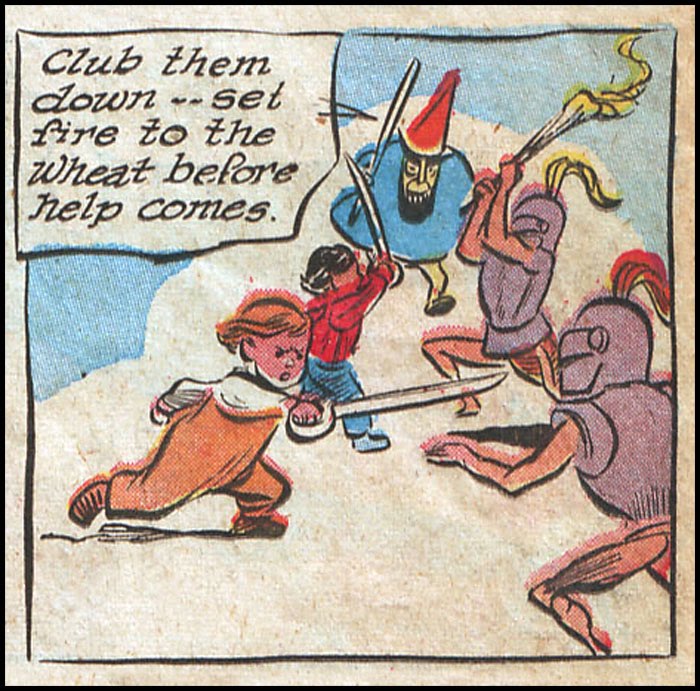
But these colors are also found in the early maps of the First Coast region as well:
 |
| map of St. Augustine, British East Florida. Thomas Jeffrey (1763) |
 |
| Sir Francis Drake lays siege to St. Augustine. Baptista Boazio (1589) |
Of course, R. Land also evokes some of his contemporaries such as Reverend Howard Finster (outsider/folk artist par excellence here in Atlanta):
 |
| Coke Bottle. Howard Finster (2001) |
 |
| Untitled. Mural in Pisa, Italy. Keith Haring (1987) |


 |
| Crocodile Hunt. Jacques Le Moyne (16th century) |
 |
| Crocodile Hunt. Jacques Le Moyne (16th century) |
 |
| Chief Saturiwa. Theodor de Bry (engraving based on Jacques Le Moyne), 16th century |
 |
| Timucua owl totem. Pre-Columbian era |
 |
| Untitled (Owls) R.Land (2008) |
Friday, October 1, 2010
Manning/Massumi Day 4
NOTE: As with all my notes from the European Graduate School, there will likely be mistakes because I did not record the lectures, I made notes as they spoke, so I am perhaps interpreting what they are saying as I am writing.
Manning & Massumi together offered two classes with us, “Emergent Space(-times)” and “The Choreographic Object – or, How movement moves us.” They were taught together and it created a fantastic experience for me.
We spent some time discussing Manning and Massumi's evening lectures from the previous two nights.
Moshé Feldenkrais, mid-20th century scientist, developed techniques for investigating how the body learns without cognition (the Feldenkrais Method). In our movements we largely operate within our idiosyncratic movement habits. Feldenkrais used, among other things, distraction to overcome these habitual movements.
Jamie Burke, a typing autist.
Spinoza's joy is a kind of affirmation that relies on an ecology.
Manning wants to foreground the craft of autistic thinking.
On this day we had to develop techniques. Our assignment was to develop a clear, concise, precise that can be shared in a 15 minute meeting with another group. Our aim is modulation, exodus, disruption, transduction of the event. How do we move the relation?
We needed to develop a transduction of these technicities, a platform for relating.
What is the representation(demonstration?) of affective tonality?
Our technique was incorporated a group being intertwined in a sheet such that if one member went in a direction the others would also have to respond to their subtle movements. The question stands, how do we transduce the sheet experience to a non-sheet experience so that the lesson can be appropriated?
Consider Gilbert Simondon. His theory of individuation holds that as we develop we alter our trajectories. In the attuning of the direction we realize that the individual points along the way are not moments of stoppage but a metastability that is always on the verge of falling apart, a precarious equilibrium.
This precariousness creates a de-phasing, what propels the transduction, a shifting of the system itself?
The choreographic object catalyzes the relationship and activates other possible interactions.
We have to develop a technique dealing with water; propositional such that it's not in an active/passive dichotomy. The key to ethics is the loss of self/ground.
The dance of attention includes human attentiveness but is not limited to the human. How does the environment attend to the unfolding of the event?
"The Thinking-Feeling of What Happens - A Semblance of a Conversation"
Brian Massumi (2008) Inflexions, no.1.
Technology that is supposed to be interactive has to act as a lure (from Whitehead) that announces its relevance in shifting our interrelationality.
 What we perceive is an act of faith - we trust that there is water in the cup in front of us (even if we can't see the water in front of us). Deleuze calls it a belief in the world - putting faith into the world - contra theology, where faith is from without.
If the virtual can maintain its form in the abstract and never appears in the real, then what is the point of that concept?
The virtual shifts and molds itself in response to the actual, a dynamic conceptual tool that is constantly reinvigorated and retooled in the shifting of its affects in the real.
The mountains of Saas-Fee seem flat and fake in the absence of clouds; we have to have the relational perception to understand their forms.
Habit holds the world up - there is no "it's just" habit.
We see, in vision, something that can't be seen without being felt - vision never just sees. There is some form of judgment in perception.
In memory we can bring out a detail that we weren't aware of in the actual experience. We can't say "we only see what we want" because we haven't been constituted by the experience yet so we can't yet put volition into the equation.
Priming in experimental psychology is preparing the following moment; our perception modulates or transitions throughout the day and we cross thresholds always being tangentially-oriented by perception as it primes our habitual action.
[The uncanny valley - how might that be part of our proprioceptive discussion?]
Perception for Massumi isn't a perception but all modes of perceiving together.
[END OF CLASS]
Manning & Massumi together offered two classes with us, “Emergent Space(-times)” and “The Choreographic Object – or, How movement moves us.” They were taught together and it created a fantastic experience for me.
We spent some time discussing Manning and Massumi's evening lectures from the previous two nights.
Moshé Feldenkrais, mid-20th century scientist, developed techniques for investigating how the body learns without cognition (the Feldenkrais Method). In our movements we largely operate within our idiosyncratic movement habits. Feldenkrais used, among other things, distraction to overcome these habitual movements.
Jamie Burke, a typing autist.
Spinoza's joy is a kind of affirmation that relies on an ecology.
Manning wants to foreground the craft of autistic thinking.
On this day we had to develop techniques. Our assignment was to develop a clear, concise, precise that can be shared in a 15 minute meeting with another group. Our aim is modulation, exodus, disruption, transduction of the event. How do we move the relation?
We needed to develop a transduction of these technicities, a platform for relating.
What is the representation(demonstration?) of affective tonality?
Our technique was incorporated a group being intertwined in a sheet such that if one member went in a direction the others would also have to respond to their subtle movements. The question stands, how do we transduce the sheet experience to a non-sheet experience so that the lesson can be appropriated?
Consider Gilbert Simondon. His theory of individuation holds that as we develop we alter our trajectories. In the attuning of the direction we realize that the individual points along the way are not moments of stoppage but a metastability that is always on the verge of falling apart, a precarious equilibrium.
This precariousness creates a de-phasing, what propels the transduction, a shifting of the system itself?
The choreographic object catalyzes the relationship and activates other possible interactions.
We have to develop a technique dealing with water; propositional such that it's not in an active/passive dichotomy. The key to ethics is the loss of self/ground.
The dance of attention includes human attentiveness but is not limited to the human. How does the environment attend to the unfolding of the event?
"The Thinking-Feeling of What Happens - A Semblance of a Conversation"
Brian Massumi (2008) Inflexions, no.1.
What is central to interactive art is not so much the aesthetic form in which a work presents itself to an audience [...] but the behaviour the work triggers in the viewer. [....] First, since an interactive work aims to evoke a behaviour in the audience, can it really do without a form that is “interesting”, and therefore in some way aesthetic? Is putting a sign up saying "You may touch the work" or "You may interact with the work" enough? When is the interaction “interesting” enough to keep the audience interacting? Can or should this interaction generate the sort of aesthetic experience that we associate with the phenomenon of art? Or is interactive art about a different kind or type of experiences, compared to more traditional art forms?
Brian Massumi: If “please interact” were enough to define a category, it would be gaming, not art. Beyond gaming in the strict sense, there is a gaming paradigm that has moved into other domains. You see it massively in communications, but also in marketing, design, training, education. Places where it becomes serious and useful. Interactivity can make the useful less boring and the serious more engaging. It is performance-enhancing.Immediately the question of form comes forward, and the assumption that vision is passive rather than active.
Technology that is supposed to be interactive has to act as a lure (from Whitehead) that announces its relevance in shifting our interrelationality.
How do you speak of form when there is the kind of openness of outcome that you see in a lot of new media art, where participant response determines what exactly happens? When the artwork doesn’t exist, because each time that it operates the interaction produces a variation, and the variations are in principle infinite? When the artwork proliferates? Or when it disseminates, as it does when the work is networked, so that the interaction is distributed in time and space and never ties back together in one particular form? To begin with, you have to get past the idea that form is ever fixed [....] The idea that there is such a thing as fixed form is actually as much an assumption about perception as it is an assumption about art. It assumes that vision is not dynamic – that it is a passive, transparent registering of something that is just there, simply and inertly. If vision is stable, then to make art dynamic you have to add movement. But if vision is already dynamic, the question changes. It’s not an issue of movement or no movement. The movement is always there in any case. So you have to make distinctions between kinds of movement, kinds of experiential dynamics, and then ask what difference they make.Hardt & Negri's "common" is pointing-out that the tragedy of the commons occurs when we assume that the commons is a resource "out there" only and can be appropriated. The Commons he (who?, I suspect it's Massumi, Hardt, Manning, and Negri) promotes is the surplus always being produced in the multiplicity.
Langer reminds us that we see things we don’t actually see. We all know it, but we tend to brush it off by calling it an illusion, as if something is happening that isn’t real, and doesn’t have anything important to say about experience. But isn’t something happening the very definition of real? The question is: what exactly does the inconvenient reality that we see things we don’t actually see say about the nature of perception? Well, it changes everything. [...]That could be another definition of real: what we can’t not experience when we’re faced with it. Instead of calling it an illusion – this movement we can’t actually see but can’t not see either – why not just call it abstract? Real and abstract. The reality of this abstraction doesn’t replace what’s actually there. It supplements it. We see it with and through the actual form. It takes off from the actual form. The actual form is like a launching pad for it. [...] The actual form and the abstract dynamic are two sides of the same experiential coin. They’re inseparable; they’re fused, like two dimensions of the same reality.The virtual and the abstract are capable of making effects felt in the world without re-dichotomizing the real and the abstract: the virtual cannot be known as such, the virtual can only be known in reference to the actual.
For example, to see an object is to see volume. We don’t infer volume. We see the voluminousness of an object, directly and immediately, without having to think about it. [...]
We see the “backedness” of it without actually seeing around to the other side. That’s precisely what makes it a perception of an object, rather than a deduction about a surface. We are really but implicitly – abstractly – seeing the object’s voluminousness. The perceived shape of an object is this abstract experience of volume. [...]
For example, We see weightiness through texture. Voluminousness and weightiness are not in themselves visible. But we can’t not see them when we see an object. In fact, we see them in the form of the object. Form is full of all sorts of things that it actually isn’t -- and that actually aren’t visible. Basically, it’s full of potential. When we see an object’s shape we are not seeing around to the other side, but what we are seeing, in a real way, is our capacity to see the other side. We’re seeing, in the form of the object, the potential our body holds to walk around, take another look, extend a hand and touch. [...]
The potential we see in the object is a way our body has of being able to relate to the part of the world it happens to find itself in at this particular life’s moment. What we abstractly see when we directly and immediately see an object is lived relation – a life dynamic. [...]
That’s the doubleness: if you’re not qualitatively seeing what isn’t actually visible, you’re not seeing an object, you’re not seeing objectively.Baudrillard's thought is still in the logic of representation and as such requires the injection of difference.
When people talk about the visual, what they are actually talking about is almost always a certain mode of what in perception studies is called a cross-modal transfer – a certain way different senses inter-operate. How, for example, does classical perspective painting create an experience of depth? By composing lines and colors in such a way as to trigger a direct experience of the potential I was talking about in relation to object awareness in so-called natural perception: the potential to advance, move around, bring backsides into view, and touch. This is a direct visual experience. [...]
Perspective painting doesn’t “trick” object-perception. It activates it otherwise. The experience of depth is not an optical “illusion.” It’s a real experience of depth, minus the depth. The experience of depth has been made to take off from its usual experiential framing and enter a different frame. [...]
When you are experiencing painted depth, you aren’t looking at a canvas, you are seeing a scene. You’re seeing through the canvas into an abstraction that it has taken off from it, and is a qualitatively different perceptual event. Your perception has been siphoned into the semblance, the canvas’s ghostly perceptual double. The semblance can’t happen without a perch in objecthood. But when it happens, it is in uncanny excess of actual objectivity. [...]
A semblance isn’t just like a force. Its “likeness” is a force, an abstract force of life. Lumière’s moving images were literally capable of launching live bodies into flight.
 What we perceive is an act of faith - we trust that there is water in the cup in front of us (even if we can't see the water in front of us). Deleuze calls it a belief in the world - putting faith into the world - contra theology, where faith is from without.
If the virtual can maintain its form in the abstract and never appears in the real, then what is the point of that concept?
The virtual shifts and molds itself in response to the actual, a dynamic conceptual tool that is constantly reinvigorated and retooled in the shifting of its affects in the real.
The mountains of Saas-Fee seem flat and fake in the absence of clouds; we have to have the relational perception to understand their forms.
Habit holds the world up - there is no "it's just" habit.
We see, in vision, something that can't be seen without being felt - vision never just sees. There is some form of judgment in perception.
In memory we can bring out a detail that we weren't aware of in the actual experience. We can't say "we only see what we want" because we haven't been constituted by the experience yet so we can't yet put volition into the equation.
Priming in experimental psychology is preparing the following moment; our perception modulates or transitions throughout the day and we cross thresholds always being tangentially-oriented by perception as it primes our habitual action.
[The uncanny valley - how might that be part of our proprioceptive discussion?]
Perception for Massumi isn't a perception but all modes of perceiving together.
[END OF CLASS]
Brian Massumi Evening Lecture
NOTE: As with all my notes from the EGS, there will likely be mistakes because I did not record the lectures, I made notes as they spoke, so I am perhaps interpreting what they are saying as I am writing.
The students are required to attend evening lectures given by the faculty each evening as part of our curriculum. Brian Massumi was the fourth person to give an evening lecture during the August sessions.
[I must apologize for the quality of my notes for this talk: I was very sick during these several days and my ability to write what I heard was very much compromised.]
This paper has a long and checkered history: exploring ritual action and not employing the symbolic but an ontogenetic force.
Thinking of ritual action also gets us reflecting on artistic practice - how art and ethical action are a force. Radical empiricism holds that everything real is felt
Walter Benjamin discussed the difference between how our ancestors danced as clouds is different from how we think of semblance today. "What is this semblance that paradoxically represents nothing?" Benjamin states, "It is relation."
What we feel in the billiard balls is the continued movement, the momentum. Semblance can't be found in snapshots - the relationship of movement is felt rather than composed of discrete units, these units exist, but the dynamism is expressed in relation to their affective tonality - the quality of movement.
The yoking of diverse moments can bring an extreme diversity because it is an expression of nonsensuous linkage (similarity?)
Being nonsensuous, activation contours are a-modal and can jump across orders. Cross-modal transference is inferior to a-modal because [....]
The body is on a life path, a worldline in movement, they are a-modal and present the opportunity to yoking a diversity of potential experience.
To this point, we've been operating with the assumption of a given subject-object relationship. Affect brings form qualitatively to life.
The emergent parent form is an a-modal emergent yoking of diversification. The child will learn to separate-out the sensuous and the objective separation of relationality.
Each new event retraces the historic unfolding traces, even as they advance the worldine. Every body stands for a potential expansion of the universe and are an archive of the shared relationship. Language is where skipping intermediaries is possible.
The autonomy of the qualitative ordering of life [....]
It's not that the world and world order are lost in thought, but language takes up these orders and moves forward the worlding. Language is the potential for movement nonsensuously [....]
Language presents worldlines in advance, language can return us to the sensuous; it's not that the world is lost in language but that we are lost in the delusions of language-speculation.
The constructive truth is pragmactic.
[thinking-feeling (xin 心)]
Through the activity of language (the coming non-local activation, aggregate relation potential), the affective is directly experienced.
Nonsensuous semblance has nothing to do with metaphor or allegory
Thought can be a force toward composition of the world operating on these relational potentialities.
Is the political in need of redefining?
Semblance - ritual action reorders the worlding in its doubling of the event; the [....]
The political needs to avoid reintroducing the content of one locality and imposing it onto another context. A bare activity that animates the other contexts as part of an expansive yoking.
[END OF TALK]
[NOTES TO SELF: ritual propriety (li 禮) requires radical pedagogy which is informed by the transmission of radical empiricism as it teaches the generation of novelty, not aberrance.
Why is peut-être both "maybe" and "perhaps" because this is an event that is activated.
Look at Deleuze's "The Exhausted" about Beckett. Also Benjamin's "On the Mimetic Faculty"
The problem with politics as a term for relationality is like the problem of pharmacy - in both concepts there is this exclusion of the pharmakoi for the purpose of maintaining an economy of what can be yoked in the City's life.
The logic of peut-être both "maybe" and "perhaps" is relationality; it's magical in that it is the allowance of expansive possibility.
Whitehead uses the term penumbra, like a cloud of gnats (from Process and Reality):
The students are required to attend evening lectures given by the faculty each evening as part of our curriculum. Brian Massumi was the fourth person to give an evening lecture during the August sessions.
[I must apologize for the quality of my notes for this talk: I was very sick during these several days and my ability to write what I heard was very much compromised.]
This paper has a long and checkered history: exploring ritual action and not employing the symbolic but an ontogenetic force.
Thinking of ritual action also gets us reflecting on artistic practice - how art and ethical action are a force. Radical empiricism holds that everything real is felt
Walter Benjamin discussed the difference between how our ancestors danced as clouds is different from how we think of semblance today. "What is this semblance that paradoxically represents nothing?" Benjamin states, "It is relation."
What we feel in the billiard balls is the continued movement, the momentum. Semblance can't be found in snapshots - the relationship of movement is felt rather than composed of discrete units, these units exist, but the dynamism is expressed in relation to their affective tonality - the quality of movement.
The yoking of diverse moments can bring an extreme diversity because it is an expression of nonsensuous linkage (similarity?)
Being nonsensuous, activation contours are a-modal and can jump across orders. Cross-modal transference is inferior to a-modal because [....]
The body is on a life path, a worldline in movement, they are a-modal and present the opportunity to yoking a diversity of potential experience.
To this point, we've been operating with the assumption of a given subject-object relationship. Affect brings form qualitatively to life.
The emergent parent form is an a-modal emergent yoking of diversification. The child will learn to separate-out the sensuous and the objective separation of relationality.
Each new event retraces the historic unfolding traces, even as they advance the worldine. Every body stands for a potential expansion of the universe and are an archive of the shared relationship. Language is where skipping intermediaries is possible.
The autonomy of the qualitative ordering of life [....]
It's not that the world and world order are lost in thought, but language takes up these orders and moves forward the worlding. Language is the potential for movement nonsensuously [....]
Language presents worldlines in advance, language can return us to the sensuous; it's not that the world is lost in language but that we are lost in the delusions of language-speculation.
The constructive truth is pragmactic.
[thinking-feeling (xin 心)]
Through the activity of language (the coming non-local activation, aggregate relation potential), the affective is directly experienced.
Nonsensuous semblance has nothing to do with metaphor or allegory
Thought can be a force toward composition of the world operating on these relational potentialities.
Is the political in need of redefining?
Semblance - ritual action reorders the worlding in its doubling of the event; the [....]
The political needs to avoid reintroducing the content of one locality and imposing it onto another context. A bare activity that animates the other contexts as part of an expansive yoking.
[END OF TALK]
[NOTES TO SELF: ritual propriety (li 禮) requires radical pedagogy which is informed by the transmission of radical empiricism as it teaches the generation of novelty, not aberrance.
Why is peut-être both "maybe" and "perhaps" because this is an event that is activated.
Look at Deleuze's "The Exhausted" about Beckett. Also Benjamin's "On the Mimetic Faculty"
The problem with politics as a term for relationality is like the problem of pharmacy - in both concepts there is this exclusion of the pharmakoi for the purpose of maintaining an economy of what can be yoked in the City's life.
The logic of peut-être both "maybe" and "perhaps" is relationality; it's magical in that it is the allowance of expansive possibility.
Whitehead uses the term penumbra, like a cloud of gnats (from Process and Reality):
Thus, in our actual world of today there is a penumbra of eternal objects, constituted by relevance to the Battle of Waterloo. Some people do admit elements from this penumbral complex into effective feeling, and others wholly exclude them. [...] The elements of this penumbra are propositional prehensions, and not pure conceptual prehensions; for their implication of the particular nexus which is the Battle of Waterloo is an essential factor. Thus an element in this penumbral complex is what is termed a 'proposition.'(185)Whitehead's is a philosophy of novelty generation so is ritual propriety (li 禮), Ames and Hall use Whitehead in their translations, necessary to avoid aberrance, or is aberrance even possible?]
Erin Manning Evening Lecture
NOTE: As with all my notes from the EGS, there will likely be mistakes because I did not record the lectures, I made notes as they spoke, so I am perhaps interpreting what they are saying as I am writing.
The students are required to attend evening lectures given by the faculty each evening as part of our curriculum. Erin Manning was the third person to give an evening lecture during the August sessions.
This talk comes from the last chapter of her forthcoming book Ethics of Language in the Making and is built from quotes from autists and those with characterized as having low-functioning autism.
The talk is particularly inspired by the work of Amanda Baggs and her amazing video, In My Language:
Mindblindness - an inability to understand what is in the mind of another. Autists don't necessarily only remain attuned to humans, but to everything else in the "theater of individuation."
What is sidestepped in the clinical model of autism is the presupposition that object relations are typical or are normative and naturally interhuman, not that they are socially-prescribed.
Metaphor as a mobility of relationality, not of representation -- they move across strata of intelligibility.
Let's also look at Tito Rajarshi Mukhopadhyay
The milieu of individuation should not mean that which is not multiple. We are multiple. The challenge is exacerbated for autists because there is this issue of translating the lived experience into language.
Pure experience doesn't exist without thought, rather language seems to privilege a modality of time and the autist's experience of time is difficult to put into our language - verbal and nonverbal in expression.
Many voices from the neurotypical communities discuss a "descent into autism" such that the trope hovers around ideas of subhuman, retarded, and a simple (false) dichotomy of human relating and ignores the possibility that neurodiversity and radical difference might inform our own lived experiences.
Language activates fields of relation; it is eminently relational and a collective individuation of sense: between words, with the words. Language acts presuppose collective activity.
Ethics are the immanent expression of the infinite potentiality in the limits of the emergent.
Language-making is the bringing-into-the-act.
[NOTE TO SELF: Psychasthenia still presupposes an essentialism that misleads us in our thinking about relationality. This talk has me rethinking. There is this problem of understanding the co-generative nature of language to communicate our loss of self]
Could the real problem be in the deliberating in order to find consensual terms; might it be that our task is to increase the attempts at communicating?
The neurotypical communities tend to underestimate the rich contributions that the autistic community can contribute to our understanding ourselves.
[END OF TALK]
The students are required to attend evening lectures given by the faculty each evening as part of our curriculum. Erin Manning was the third person to give an evening lecture during the August sessions.
This talk comes from the last chapter of her forthcoming book Ethics of Language in the Making and is built from quotes from autists and those with characterized as having low-functioning autism.
The talk is particularly inspired by the work of Amanda Baggs and her amazing video, In My Language:
Mindblindness - an inability to understand what is in the mind of another. Autists don't necessarily only remain attuned to humans, but to everything else in the "theater of individuation."
What is sidestepped in the clinical model of autism is the presupposition that object relations are typical or are normative and naturally interhuman, not that they are socially-prescribed.
Metaphor as a mobility of relationality, not of representation -- they move across strata of intelligibility.
Let's also look at Tito Rajarshi Mukhopadhyay
The milieu of individuation should not mean that which is not multiple. We are multiple. The challenge is exacerbated for autists because there is this issue of translating the lived experience into language.
Pure experience doesn't exist without thought, rather language seems to privilege a modality of time and the autist's experience of time is difficult to put into our language - verbal and nonverbal in expression.
Many voices from the neurotypical communities discuss a "descent into autism" such that the trope hovers around ideas of subhuman, retarded, and a simple (false) dichotomy of human relating and ignores the possibility that neurodiversity and radical difference might inform our own lived experiences.
Language activates fields of relation; it is eminently relational and a collective individuation of sense: between words, with the words. Language acts presuppose collective activity.
Ethics are the immanent expression of the infinite potentiality in the limits of the emergent.
Language-making is the bringing-into-the-act.
[NOTE TO SELF: Psychasthenia still presupposes an essentialism that misleads us in our thinking about relationality. This talk has me rethinking. There is this problem of understanding the co-generative nature of language to communicate our loss of self]
Could the real problem be in the deliberating in order to find consensual terms; might it be that our task is to increase the attempts at communicating?
The neurotypical communities tend to underestimate the rich contributions that the autistic community can contribute to our understanding ourselves.
[END OF TALK]
Subscribe to:
Posts (Atom)


 Posts
Posts


