Okinawa is an occupied island. And this can be read in two ways: the U.S. controls, what seems to be, most of the island (and so there are really large bases all over the place - in fact, you can't google maps the northern part of the island); but the Japanese also occupy Okinawa. The Okinawans are a distinctly different ethnic group and the Japanese are very quick to point out they aren't "really Japanese." But that's alright, ultimately, because teh Okinawans are a peace-loving people. They erect war memorials to all sides of the WWII conflicts and make concerted efforts to discuss peace making at all public venues. In the spirit of the Okinawans I present the following:
Here's a link to what seems to be the shortest war in history (38 long minutes)
http://en.wikipedia.org/wiki/Anglo-Zanzibar_War
Here's a link to a story about a french nuclear physicist that staged a one man invasion of the island of Sark in Britain
http://en.wikipedia.org/wiki/Sark
I just thought you'd like to know that the world is big enough for these kinds of events.
From the above, we get this interesting legal device; maybe the Uchinanchu (Okinawans) could use it:
http://en.wikipedia.org/wiki/Clameur_de_haro
What happened to my music posting thingy? I'm listening to "Illinois" by Sufjan Stevens and I wish that I had some new music.
Sunday, April 20, 2008


Tuesday, January 22, 2008
News Mash-Up (How to Read the Media Primer)
So, there's a lot of "news" right now. I'm going to focus on one event (the Fed cut the interest rate) and you read the following and tell me which one do I think is drving the following "news" reports, enjoy!
Pre-emptive nuclear strike a key option, Nato told
Ian Traynor in Brussels
Tuesday January 22, 2008
The Guardian
The west must be ready to resort to a pre-emptive nuclear attack to try to halt the "imminent" spread of nuclear and other weapons of mass destruction, according to a radical manifesto for a new Nato by five of the west's most senior military officers and strategists….
The five commanders argue that the west's values and way of life are under threat, but the west is struggling to summon the will to defend them. The key threats are:
· Political fanaticism and religious fundamentalism.
· The "dark side" of globalisation, meaning international terrorism, organised crime and the spread of weapons of mass destruction.
· Climate change and energy security, entailing a contest for resources and potential "environmental" migration on a mass scale.
· The weakening of the nation state as well as of organisations such as the UN, Nato and the EU.
A New, Global Oil Quandary: Costly Fuel Means Costly Calories
By KEITH BRADSHER
Published: January 19, 2008
New York Times
Rising prices for cooking oil are forcing residents of Asia's largest slum, in
This is the other oil shock. From
No category of food prices has risen as quickly this winter as so-called edible oils — with sometimes tragic results. When a Carrefour store in
Cooking oil may seem a trifling expense in the West. But in the developing world, cooking oil is an important source of calories and represents one of the biggest cash outlays for poor families, which grow much of their own food but have to buy oil in which to cook it. …
[…]The food price index of the Food and Agriculture Organization of the United Nations, based on export prices for 60 internationally traded foodstuffs, climbed 37 percent last year. That was on top of a 14 percent increase in 2006, and the trend has accelerated this winter.
Markets in Flux After Fed Move
By VIKAS BAJAJ and KEITH BRADSHER
Published: January 22, 2008
New York Times
The Fed cut rates a week before a regularly scheduled meeting and about an hour before markets opened in New York
President Bush's State of the Union address is scheduled for Monday, January 28, 2008 at 9pm
Answer Key in next transmission.Here's a hint: the food thing is not "news" people have been saying that for over a decade.
Appended at 3:22 pm
Here's a photo for all of you that think that the Fed can "do something" and the economy will just get better:
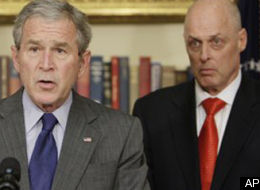
we're very confident.
Thursday, January 17, 2008
Remembering Reagan - He Nearly Killed Us All
The Following from Rick Perlstein, it is repeated from a piece he wrote at Reagan's death in 2004:
Nowadays, as we grapple with the malevolence of President Bush, it's Reagan we remember as the sensible one. At the risk of speaking ill of the dead, let memory at least acknowledge that there was much about Reagan that was not so sensible.
Just wanna remind you that we are responsible for the histories we teach. This election, listen to the histories the candidates are fabricating.
Nowadays, as we grapple with the malevolence of President Bush, it's Reagan we remember as the sensible one. At the risk of speaking ill of the dead, let memory at least acknowledge that there was much about Reagan that was not so sensible.
Again and again as president, Reagan let it slip that he concurred with fundamentalists' belief that the world would end in a fiery Armageddon. This did not hurt him politically. The kind of people offended by such talk had already largely abandoned the Republican Party. Those attracted by it -- evangelicals who had gone overwhelmingly for fellow evangelical Jimmy Carter in 1976 -- adopted Reagan, and his conservative Republicanism, as their own, and they never looked back. And in the eschatology of Cold War America, Christian apocalyptic thinking had everything to do with the assumption that the Armageddon would be a nuclear one, a confrontation with the anti-Christ bailiwick Russia, which Reagan identified in a March 1983 speech to the National Association of Evangelicals as the "Evil Empire."
No wonder that when, in November 1983, NATO launched a war games exercise code-named Able Archer, the Soviet Union misread its intentions as offensive and put its nuclear forces on alert, and the world came closer to ending than it ever had before.
It took this near miss -- and not, certainly, the largest mass demonstration in American history, the million people who gathered in Central Park in 1982 to demonstrate for a nuclear freeze (another moment you probably won't read about in all the Reagan eulogies) -- to get Reagan thinking seriously about negotiating an arms control agreement with the Soviet Union. To his enormous credit.
But he never did make a similar peace with the "welfare queens" he fabricated out of whole cloth to push his anti-compassionate conservatism. Nor with the African Americans he insulted by launching his 1980 presidential campaign in Philadelphia, Miss., where three civil rights workers were slaughtered by the Ku Klux Klan in 1964. Nor with the Berkeley students demonstrating in a closed-off plaza whom he ordered tear-gassed by helicopter in 1969.
Nor, last but not least, with the tens of thousands of AIDS corpses whose disease he did not even deign to publicly acknowledge until 1987.
As the eulogies come down the pike, don't let conservatives, once again, win the ideological struggle to determine mainstream discourse. Remember Reagan; respect him. But don't let them make you revere him. He was a divider, not a uniter.
You may also want to read about the man who saved the world during Reagan's administration, here.Just wanna remind you that we are responsible for the histories we teach. This election, listen to the histories the candidates are fabricating.
Monday, January 14, 2008
On the New Serfdom
from:
The New Road to Serfdom: An illustrated guide to the coming real estate collapse
By Michael Hudson
posted on iTulip:
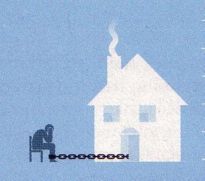
Free markets are based on choice. But more and more homeowners are discovering that what they got for their money is fewer and fewer choices. A real estate boom that began with the promise of "economic freedom" almost certainly will end with a growing number of workers locked in to a lifetime of debt service that absorbs every spare penny. Indeed, a study by The Conference Board found that the proportion of households with any discretionary income whatsoever had already declined between 1997 and 2002, from 53 percent to 52 percent. Rising interest rates, rising fuel costs, and declining wages will only tighten the squeeze on debtors.
But homeowners are not the only ones who will pay. The overall economy likely will shrink as well. That $200 billion that flowed into the "real" economy in 2004 is already spent, with no future capital gains in the works to fuel more such easy money. Rising debt-service payments will further divert income from new consumer spending. Taken together, these factors will further shrink the "real" economy, drive down those already declining real wages, and push our debt-ridden economy into Japan-style stagnation or worse. Then only the debt itself will remain, a bitter monument to our love of easy freedom.
The New Road to Serfdom: An illustrated guide to the coming real estate collapse
By Michael Hudson
posted on iTulip:
Free markets are based on choice. But more and more homeowners are discovering that what they got for their money is fewer and fewer choices. A real estate boom that began with the promise of "economic freedom" almost certainly will end with a growing number of workers locked in to a lifetime of debt service that absorbs every spare penny. Indeed, a study by The Conference Board found that the proportion of households with any discretionary income whatsoever had already declined between 1997 and 2002, from 53 percent to 52 percent. Rising interest rates, rising fuel costs, and declining wages will only tighten the squeeze on debtors.
But homeowners are not the only ones who will pay. The overall economy likely will shrink as well. That $200 billion that flowed into the "real" economy in 2004 is already spent, with no future capital gains in the works to fuel more such easy money. Rising debt-service payments will further divert income from new consumer spending. Taken together, these factors will further shrink the "real" economy, drive down those already declining real wages, and push our debt-ridden economy into Japan-style stagnation or worse. Then only the debt itself will remain, a bitter monument to our love of easy freedom.
Saturday, January 12, 2008
Quick Question to All Y’all and Thoughts on Poverty Alleviation
Are you finding this stuff worth reading?
Is there a topic you'd rather I focus on?
Is there a topic you'd rather I focus on?
I'm visiting my mom today in North Cackalackey (sorry, Ari, I am only here for the day) and we're talking about my year of service (we've not really talked about it all this year and I think my work may be a little confusing unless I give a more thorough explanation of what I do).
Anywho, we're talking today and I realized that one of the best poverty-reducing institutions I can think of is the bank account. 30 million Americans operate without bank accounts according to the Aspen Institute.
How would a bank account help alleviate poverty? A bank account is a neutral thirda party accounting tool. It simply says how much was spent, when, and where. But, having that statement shows you what your actual income is. It tells you what your cash flow really looks like. I get dozens of people across my desk who say their cash flow is great because they have a thousand dollars in their account. When I do a three month analysis, however, I see that the person actually had a large deposit (say a tax return) in one month and has generally been spending tow or three hundred dollars more than they earn every month. That means that although they may have money in the bank, they actually have negative cash flow.
A bank account teaches people at least two REALLY IMPORTANT lessons about being poor in America:
1) it costs more for a poor person to purchase things that middle- and upper-class families buy and need:
If you're poor, you probably have poor credit. That means your car payment interest is higher, your mortgage payment is higher, your car insurance is higher (that's right, they use your credit report to determine what your insurance will cost).
2) it costs money to have the money you earned by working:
If you're poor you probably don't realize the relative cost of banking fees are. I have a client that spends on average $55-75 a month just in fees for using the debit card. Why? ATM fees, fees for using your card to purchase groceries (a PIN-based transaction fee is usually how it's stated)
SORRY, I have to go now; I will post later
Anywho, we're talking today and I realized that one of the best poverty-reducing institutions I can think of is the bank account. 30 million Americans operate without bank accounts according to the Aspen Institute.
How would a bank account help alleviate poverty? A bank account is a neutral thirda party accounting tool. It simply says how much was spent, when, and where. But, having that statement shows you what your actual income is. It tells you what your cash flow really looks like. I get dozens of people across my desk who say their cash flow is great because they have a thousand dollars in their account. When I do a three month analysis, however, I see that the person actually had a large deposit (say a tax return) in one month and has generally been spending tow or three hundred dollars more than they earn every month. That means that although they may have money in the bank, they actually have negative cash flow.
A bank account teaches people at least two REALLY IMPORTANT lessons about being poor in America:
1) it costs more for a poor person to purchase things that middle- and upper-class families buy and need:
If you're poor, you probably have poor credit. That means your car payment interest is higher, your mortgage payment is higher, your car insurance is higher (that's right, they use your credit report to determine what your insurance will cost).
2) it costs money to have the money you earned by working:
If you're poor you probably don't realize the relative cost of banking fees are. I have a client that spends on average $55-75 a month just in fees for using the debit card. Why? ATM fees, fees for using your card to purchase groceries (a PIN-based transaction fee is usually how it's stated)
SORRY, I have to go now; I will post later
Friday, January 11, 2008
One Last Taxes Blog
Okay, well, maybe I'm doing you a favor as you go into tax season by talking about taxes in an election year.
That's right, the banks are arguing that they're not responsible for the recession because EXCEL IS TOO HARD TO USE.
Well, it wouldn't be a big deal, I suppose, except for the fact that since this Bush came to office we've been fighting a recession by stimulating the generation of long term loans we call mortgages. Why do this instead of promote long term growth through paying down debt or promoting government spending on education and grants to scientists? I don't know why not. That's not what this administration and those within our government wanted to support.
Probably because those supporters of less government intervention (let the markets fix themselves, that's fair) believe that tax cuts (reducing the amounts of taxes individuals pay) have a stimulating effect on the ecnomy.
They say that instead of paying the government, those individuals will invest in the market (remember the dot-com crash?), or save (Americans now carry thousands more in debt than in savings), or create jobs (unemployment is expected to return to 6% because housing construction has ceased). Here are some graphs from AngryBear's blog:
This should be a no-brainer becuase if you ask someone who actually makes a lot of money they will tell you that paying more in taxes shows that you've made more money.
Why did Carnegie give away all that money? He knew, and stated that he knew, that he made his fortune by exploiting the conditions of his society. He felt he had to give back the largest portion of it so that society would benefit somewhat from his exploitation in the end.
Further, your taxes are there to support you, citizen. You like that road? Your taxes built it. You like that park? Your taxes paid for it. You like that there is less crime? Your taxes are used to alleviate the pressures that lead to crime.
And now, a final note about why you want to better understand taxes and what is unfair about the tax code today. I want to talk about the Earned Income Tax Credit (EITC). The following is from the Atlanta Prosperity Campaign:
What's unfair is that there are numerous opportunities for large corporations to avoid paying taxes and they have the financial resources to pay for accountants to find those opportunities. Those accountants, then, turn around (once the egg is on their faces) and make some hare-brained response like the one we have above.
Fact is, you're not going to get much more than rhetoric from the candidates (ever) and I feel that if you're going to have an opinion it should be based on reflection and deliberation with the facts as they lay.
Today I point you to Paul Krugman and AngryBear as they dove tail nicely around the question of how government intervention affects (I don't mean "effects") the economy.
Right now there is talk about the Federal Reserve cutting the lending rate, again, this time an anticipated .5%; but what does that mean? From Krugman's Post :
Today I point you to Paul Krugman and AngryBear as they dove tail nicely around the question of how government intervention affects (I don't mean "effects") the economy.
Right now there is talk about the Federal Reserve cutting the lending rate, again, this time an anticipated .5%; but what does that mean? From Krugman's Post :
Monetary policy mainly exerts its influence through housing: high interest rates squeeze home construction, low rates encourage it. Interest rates have much less direct effect on business investment. The reason? Housing lasts much longer.
Suppose you take out a loan to buy a machine whose economic life is only 5 years — which is highly likely, given both physical wear and tear and technological obsolescence. How much difference does it make whether the interest rate on the loan is 4 percent or 6 percent? Not much: the monthly payment on a 5-year loan at 4% is less than 5% lower than the monthly payment on a loan at 6%. So interest rates don't have much effect on business investment.
On the other hand, suppose you buy a house with a 30-year mortgage. The monthly payment on a 4% mortgage is more than 20 percent lower than on a 6% mortgage. So interest rates make a lot of difference to housing.
So here's what normally happens in a recession: the Fed cuts rates, housing demand picks up, and the economy recovers.
Krugman goes on to point out that the problem with this strategy, this time, is that the source of recessionary pressure lies largely with the housing market, itself. This happened because accounting for banks changed (the following from Calculated Risk):The accounting rule in question, Financial Accounting Standard 114, was adopted in 1993. Lynn E. Turner, a former chief accountant of the Securities and Exchange Commission, recalls that it was enacted because of abuses by financial institutions during the savings and loan debacle. Under the old rule, banks could avoid reporting losses so long as they expected to get the principal back eventually, even if the borrower did not have to pay interest on the restructured loan. The rule put an end to that.
Or at least it put an end to it for most types of loans. These banks live with F.A.S. 114 for their commercial mortgages and corporate loans, but according to Ms. Utermohlen, they don't have systems in place to do the calculations for large numbers of restructured residential mortgage loans.
The calculations, it turns out, are not that complicated. You could do them with a decent financial calculator, or an Excel spreadsheet. But the banks argue that would take too much effort, given the volume of loans likely to be restructured. "This would be extremely time-consuming and would likely involve additional staff dedicated to this purpose," Ms. Utermohlen said in a letter to the Financial Accounting Standards Board this week.
(emphasis added)Or at least it put an end to it for most types of loans. These banks live with F.A.S. 114 for their commercial mortgages and corporate loans, but according to Ms. Utermohlen, they don't have systems in place to do the calculations for large numbers of restructured residential mortgage loans.
The calculations, it turns out, are not that complicated. You could do them with a decent financial calculator, or an Excel spreadsheet. But the banks argue that would take too much effort, given the volume of loans likely to be restructured. "This would be extremely time-consuming and would likely involve additional staff dedicated to this purpose," Ms. Utermohlen said in a letter to the Financial Accounting Standards Board this week.
That's right, the banks are arguing that they're not responsible for the recession because EXCEL IS TOO HARD TO USE.
Well, it wouldn't be a big deal, I suppose, except for the fact that since this Bush came to office we've been fighting a recession by stimulating the generation of long term loans we call mortgages. Why do this instead of promote long term growth through paying down debt or promoting government spending on education and grants to scientists? I don't know why not. That's not what this administration and those within our government wanted to support.
Probably because those supporters of less government intervention (let the markets fix themselves, that's fair) believe that tax cuts (reducing the amounts of taxes individuals pay) have a stimulating effect on the ecnomy.
They say that instead of paying the government, those individuals will invest in the market (remember the dot-com crash?), or save (Americans now carry thousands more in debt than in savings), or create jobs (unemployment is expected to return to 6% because housing construction has ceased). Here are some graphs from AngryBear's blog:
Below is a graph showing the annual growth in real GDP per capita, by president starting with Ike, sorted from fastest growth to slowest growth. Data comes from the BEA's NIPA table 7.1. For each president, its calculated from the last year before the President took office to the last full year the President served. (Since JFK was killed and Nixon quit more than half-way through the year, I assumed JFK's "last full year" was 1963 and Nixon's was 1974.)

Now, another graph... This one shows the annual change in taxes as a percent of personal income. With the same color scheme. (I hope you've figured it out!!) This includes taxes on labor and capital gains. The data comes from the IRS.

That's right: the less you tax individuals (now remember, a corporation is by law an individual and given the same or more rights and protections as a human being), the less the economy has benefited.Now, another graph... This one shows the annual change in taxes as a percent of personal income. With the same color scheme. (I hope you've figured it out!!) This includes taxes on labor and capital gains. The data comes from the IRS.
This should be a no-brainer becuase if you ask someone who actually makes a lot of money they will tell you that paying more in taxes shows that you've made more money.
Why did Carnegie give away all that money? He knew, and stated that he knew, that he made his fortune by exploiting the conditions of his society. He felt he had to give back the largest portion of it so that society would benefit somewhat from his exploitation in the end.
Further, your taxes are there to support you, citizen. You like that road? Your taxes built it. You like that park? Your taxes paid for it. You like that there is less crime? Your taxes are used to alleviate the pressures that lead to crime.
And now, a final note about why you want to better understand taxes and what is unfair about the tax code today. I want to talk about the Earned Income Tax Credit (EITC). The following is from the Atlanta Prosperity Campaign:
The EITC is a tax benefit for low- to moderate-income working families. U.S. Census Data show that in 2003, the EITC lifted 4.4 million people out of poverty, including 2.4 million children – more than any other single program or category of programs. Without the EITC, the poverty rate among children would have been nearly one-fourth higher. For tax year 2005, 79,338 households in the city of Atlanta Atlanta
If an individual qualifies for the EITC, he or she might also qualify for the Advance EITC, which allows workers to receive part of their refund in their paychecks during the year. It provides an opportunity for employers to effectively give their employees a raise without having to increase their salary. To increase enrollment in the Advance EITC, employers need only to be equipped with the knowledge and the tools to help their employees apply for the program.
(The emphases, obviously, are mine.)What's unfair is that there are numerous opportunities for large corporations to avoid paying taxes and they have the financial resources to pay for accountants to find those opportunities. Those accountants, then, turn around (once the egg is on their faces) and make some hare-brained response like the one we have above.
Thursday, January 10, 2008
More About Flat/Fair Taxes
I'm glad to see y'all are willing to look over some of this economic stuff. I'm hoping that y'all will begin to look to these blogs as a starting point for forming your own opinions and gaining a better understanding of what we have traditionally been made to feel was not accessible.
I particularly like how he ends it:
The question from two folks was, "but there is a difference between flat taxes and "the fair tax." There ain't. Both are simply euphemisms for regressive taxation. What we have now is a progressive tax, where the more you make the more you get taxed. In theory. As you will read in Angry Bear's Experiment here, to understand better what is at stake in all this tax talk is this:
"If you don't believe a flat tax (or "fair tax") on the books is really regressive in practice, ask yourself these two questions:
a) Who gets a greater percentage of her income from tax free munis - Paris Hilton or a maid who works at the Hilton?
and b) Who is more likely to retain the services of a high powered tax services company which knows all the loopholes that can be used to shield income or inflate costs, and who is more likely to get a W-2 - Paris Hilton or a maid who works at the Hilton?
As to a consumption tax like the flat tax, all you need is one question: who has to spend a greater percentage of his income just to keep body and soul together each and every year of his life - Steve Forbes or a janitor at the magazine that Forbes inherited?"
What I really appreciate about this posting is that the attempt to make the neocon argument is there. Read it through and I think you will see that the what is actually being argued for by these ideologues is not fairness.a) Who gets a greater percentage of her income from tax free munis - Paris Hilton or a maid who works at the Hilton?
and b) Who is more likely to retain the services of a high powered tax services company which knows all the loopholes that can be used to shield income or inflate costs, and who is more likely to get a W-2 - Paris Hilton or a maid who works at the Hilton?
As to a consumption tax like the flat tax, all you need is one question: who has to spend a greater percentage of his income just to keep body and soul together each and every year of his life - Steve Forbes or a janitor at the magazine that Forbes inherited?"
I particularly like how he ends it:
these are, to the best of my ability, honest arguments for something that a lot of people really want to see happen. But they don't have the decency to make the honest argument for it. And you can't have a debate with a grifter.
Amen.
Why Flat Taxers Are Nuts
It's an election year, you've seen the pick-up trucks and minivans with the flat tax stickers; you hear the rhetoric about the middle class being pinched. What does it all mean? What are we supposed to do? I was talking with a friend that I love to death and I usually think is a really smart, right-on kinda fellah. Then he started spewing that vitriol about flat taxes and I had to keep my jaw from falling off my face and onto the table and then rolling over to him and punching him in the penis.
That's when I realized that he was way too smart to be talking like one of those economic hacks; and so I am sharing with you some resources that will try to explain how taxes work and why flat taxes won't.
So, flat taxers tend to congregate around a constellation of beliefs, among the most humorous is that government intervention will only lead to botched efforts and unnecesary influence in the market. This is of course preposterous because if the market were allowed to run its course we may likely still have slaves, Irish wouldn't be allowed to vote and women would likely only have recourse to property rights.
Look to the real estate market right now for an example of how markets don't "correct" themselves naturally - people will hold onto the values they believe in until some other agent (by means of force, whether economic or military) enjoins them to shed that value in exchange for another. Another example of this would be to look at how quickly Americans were willing to shed their civil liberties (a long held value) in exchange for a new value called "security." But I digress....
Discussion of How Taxes Work:
http://bigpicture.typepad.com
http://economistsview.typepad
Are We Paying Too Much in Taxes?
http://bigpicture.typepad.com
The Cult of Supply-side Economics
http://economistsview.typepad
How Do Tax Changes Effect the GDP?
http://www.econbrowser.com
Republicans and their corporate tax cuts:
http://angrybear.blogspot.com
That's when I realized that he was way too smart to be talking like one of those economic hacks; and so I am sharing with you some resources that will try to explain how taxes work and why flat taxes won't.
So, flat taxers tend to congregate around a constellation of beliefs, among the most humorous is that government intervention will only lead to botched efforts and unnecesary influence in the market. This is of course preposterous because if the market were allowed to run its course we may likely still have slaves, Irish wouldn't be allowed to vote and women would likely only have recourse to property rights.
Look to the real estate market right now for an example of how markets don't "correct" themselves naturally - people will hold onto the values they believe in until some other agent (by means of force, whether economic or military) enjoins them to shed that value in exchange for another. Another example of this would be to look at how quickly Americans were willing to shed their civil liberties (a long held value) in exchange for a new value called "security." But I digress....
So Flat Taxers (hereon, Flatheads) believe that consumption itself should be taxed, n'est-ce pas? The belief is that spending is universal and regular and the economy does not have phases, etc. Those Flatheads take the assumption that people will always by stuff and this is nearly a good observation, "Look to the Phillipines, the per capita income their is ridiculously low, yet, per capita cell phone use is through the roof! Even poor people will buy expensive stuff!" This is an example of how those who believe in the Flat Tax will support their argument. But it doesn't have any explanatory power.
The logical question to the above would be, "Well, how much does it cost relative to the income of those poor Filipinos to own a cell phone? Do they even own the phone? How much does it cost to use a cell phone and how does it compare to us?" Instead of explaining why it makes economic sense to have a cell phone in the Phillipines, the Flathead rather uses the above to make an emotional appeal, the flavor of which would be, "hey, taxes are unfair, poor people are poor 'cause they make dumb decisions and the rich can afford to not pay, so why should I?"
The Flat Tax, as sold to me, is usually not about economic justice (it doesn't address the fact that the CEOs of firms make 500-1000 times more than their base employees); it's usually sold with a punitive streak smeared a mile wide across the class line. The rich support the flat tax because they will pay less taxes, the lower-middle class support it 'cause they think poor people are directly benefiting from their own hardships, and no one cares how the poor fit in to all this.
What the flat tax proposes to do is tax people on how much they spend per month; those who make very little money would get a "pre-bate" each money to defray the cost of getting basic goods. What this doesn't address are serious are sad: what would the motivation to work be, then? Most importantly, the actual cost to those with little money would be MUCH GREATER THAN it is today. The rich would do exactly what they've always done - pay the minimal amount of taxes they feel comfortable with; those that are serially poor and unconcerned about "contributing to society" would continue to not work as they would still receive their "prebate" and the working-poor and those just barely able to be middle class would become permanently poor because the relative cost this consumption tax would be more like 50% of their actual income.
What if large groups of people cannot purchase a home, what does that do to tax generation?
http://calculatedrisk.blogspot
this is one of my favorite blogs, by the by.
http://calculatedrisk.blogspot
this is one of my favorite blogs, by the by.
Here's some (light) reading on taxes and are great for discussion and analysis of tax proposals and their real effects on the economy and perhaps on individuals
Also, understand what poverty really looks like in Georgia:
"1 in 3 counties in Georgia have been deemed 'Persistently Poor' meaning 20% or more of their population have lived in poverty over the past three decades."www.cviog.uga.edu/services
Discussion of How Taxes Work:
http://bigpicture.typepad.com
http://economistsview.typepad
Are We Paying Too Much in Taxes?
http://bigpicture.typepad.com
The Cult of Supply-side Economics
http://economistsview.typepad
How Do Tax Changes Effect the GDP?
http://www.econbrowser.com
Republicans and their corporate tax cuts:
http://angrybear.blogspot.com
Understanding Capital Gains tax implications:
http://angrybear.blogspot.com
http://angrybear.blogspot.com
Friday, December 14, 2007
"5 Myths About Torture" That I Must Share
from the Washington Post
So the CIA did indeed torture Abu Zubaida, the first al-Qaeda terrorist suspect to be waterboarded. So says John Kiriakou, the first former CIA employee directly involved in the questioning of "high-value" al-Qaeda detainees to speak publicly. He minced no words last week in calling the CIA's "enhanced interrogation techniques" what they are.
But did they work? Torture's defenders, including the wannabe tough guys who write Fox's "24," insist that the rough stuff gets results. "It was like flipping a switch," said Kiriakou about Abu Zubaida's response to being waterboarded. But the al-Qaeda operative's confessions -- descriptions of fantastic plots from a man whom journalist Ron Suskind has reported was mentally ill -- probably didn't give the CIA any actionable intelligence. Of course, we may never know the whole truth, since the CIA destroyed the videotapes of Abu Zubaida's interrogation. But here are some other myths that are bound to come up as the debate over torture rages on.
1 Torture worked for the Gestapo.
Actually, no. Even Hitler's notorious secret police got most of its information from public tips, informers and interagency cooperation. That was still more than enough to let the Gestapo decimate anti-Nazi resistance in Austria, Czechoslovakia, Poland, Denmark, Norway, France, Russia and the concentration camps.
Yes, the Gestapo did torture people for intelligence, especially in its later years. But this reflected not torture's efficacy but the loss of many seasoned professionals to World War II, increasingly desperate competition for intelligence among Gestapo units and an influx of less disciplined younger members. (Why do serious, tedious police work when you have a uniform and a whip?) It's surprising how unsuccessful the Gestapo's brutal efforts were. They failed to break senior leaders of the French, Danish, Polish and German resistance. I've spent more than a decade collecting all the cases of Gestapo torture "successes" in multiple languages; the number is small and the results pathetic, especially compared with the devastating effects of public cooperation and informers....
Baseball's fixed, the economy's being run by folks who don't know any better than you and me, we have no foreign policy strategy, and we're no longer "the good guy" that I thought we should be.
Why's the country in such a bad way? We have poor leadership. Any asshole can start a war, happens all the time, it takes finesse and skill to harmonize relations. Any old blowhard (black, white, female, even Mormon) can confidently state that things need to change in Washington. Well start, then, by calling a spade a spade: torture is unAmerican, our economy sucks because we have a government that spends too much and produces too little and this ties into our foreign policy problems:
Economy's in bad shape? Start a war. A war is like a candy bar for your body's caloric-intake needs. Wars produce a spike in production (someone's gotta manufacture those bombs and bullets) and as we see with Blackwater, there are a host of companies that bid for the contracts for killing and (de)stabilizing foreign locales. Candy bars give you a boost in simple carbohydrates which are pure energy, but they fizzle-out quickly, the energy is not a smart choice unless you eat the candy bar and then start running at top speed for the next 30 minutes or more.
The same is true with war expenditures, and more so, because what an economy really needs is prolonged bouts of stability not only domestically but also abroad. We need young men and woment that will start businesses and manufacture widgets and have children and we need trade partners (other countries) that are in the same situation.
In a world where we can torture, the only longterm effect I can foresee is a general rise in distrust and suspicion; a cutting-off of compassion and a lot less goodwill.
Friday, November 30, 2007
Some Dog Stuff
This is another thought collage about in the "Age of Crushed Skulls" series, it originally appeared on Friday, February 16, 2007.
So I am writing about dogs, culture and something more (but what?) and I was overwhelmed by how amazing dogs really are. Listen to them sing:
african wild dog
puppy
Doberman
wolf
fox
basset hound
They even form choruses:
blood hounds
New Guinea Singing dogs
I mean, really I can't express to what degree I am really shocked at how versatile these animals can be in their expression.
So I am writing about dogs, culture and something more (but what?) and I was overwhelmed by how amazing dogs really are. Listen to them sing:
african wild dog
puppy
Doberman
wolf
fox
basset hound
They even form choruses:
blood hounds
New Guinea Singing dogs
I mean, really I can't express to what degree I am really shocked at how versatile these animals can be in their expression.
The Age of Crushed Skulls (Update!!!!)
This is a follow-up to the last blog of this title and appeared on my other blog on Monday, December 11, 2006.
Forgive that these blogs are, at best, a long aphorism. They are bread crumbs I'm leaving as I think about culture and its transmission. There's something, in my xin (heart-and-mind) that tells me that how we understand dogs, the history of the peoples of the Silk Road, and prehistory says much more about who we are today than what it says about any of those topics.
http://www.nature.com/ng/journal/vaop/ncurrent/abs/ng1946.html
Follow the above link to read about a recently published article discussing the evolution of homo sapiens sapiens.
In the original "Age of Crushed Skulls" scenario I briefly alluded to technology and reproduction, i.e. those with technology reproduced because they crushed others' skulls.
Furthermore, I was trying to suggest in the previous edition that culture itself is THE technology that you gotta get behind. What? Why? See the above article.
It seems that the ability to digest milk (by not allowing the lactase enzyme to be "turned off") is a result of environmental pressures. Those who "became" pastoralists were able to have more energy resources available to them than were those who were unable to consume the milk of the cattle. In fact, they lost valuable water with diarrhea whereas those who were lactose tolerant had more water and the sugar-energy available by breaking down the milk.
Also of note, the "Funnel Beaker" culture of northern Europe seems to be tremendously successful in maintaining this trait to this day (where something on the order of 99% of Swedes are lactose tolerant today).
Why is this of any significance? Typically the social sciences (including political science and economics) think of culture in terms of largely stagnant pools. So, saying something like, "Those Iraqis are not ready for democracy," or more scarily assuming that democracy is something "we" got and they don't know they want. This stagnant pools idea which tends to guide institutional thinking assumes a fixity of identity within the objects being observed.
The objects being observed are in this case pastoralists, industrialists, nomads, gatherer/hunters, etc. It is assumed that the mode of economic production (being a farmer, being a ceo of a multinational company, being a shepherd) largely determines "why" people act the way they do.
I kinda resist this thinking, though, because it's kinda puttin the cart before the horse. What I mean is this: people are more or less co-conspirators in their environment and are the deliberated, mutually-influencing product of this exchange. That is, you're not really born a pastoralist or a ceo; you're born a culture-producing machine. Given the appropriate resources, any schnuck could be an astronaut, or a sherpa. (Plainly I am broadly conceptualizing resources here, but that's the thrust of my thinking here).
If it's the case that people have always been dumb and lazy, with brilliant examples generously sprinkled throughout for countermeasure, then there really shouldn't be any kind of talk of violence between peoples as a natural result of who they are. I'm trying to work through what Zizek was writing about last year after the riots in paris and new orleans and iraq.
More later...
Forgive that these blogs are, at best, a long aphorism. They are bread crumbs I'm leaving as I think about culture and its transmission. There's something, in my xin (heart-and-mind) that tells me that how we understand dogs, the history of the peoples of the Silk Road, and prehistory says much more about who we are today than what it says about any of those topics.
http://www.nature.com/ng/journal/vaop/ncurrent/abs/ng1946.html
Follow the above link to read about a recently published article discussing the evolution of homo sapiens sapiens.
In the original "Age of Crushed Skulls" scenario I briefly alluded to technology and reproduction, i.e. those with technology reproduced because they crushed others' skulls.
Furthermore, I was trying to suggest in the previous edition that culture itself is THE technology that you gotta get behind. What? Why? See the above article.
It seems that the ability to digest milk (by not allowing the lactase enzyme to be "turned off") is a result of environmental pressures. Those who "became" pastoralists were able to have more energy resources available to them than were those who were unable to consume the milk of the cattle. In fact, they lost valuable water with diarrhea whereas those who were lactose tolerant had more water and the sugar-energy available by breaking down the milk.
Also of note, the "Funnel Beaker" culture of northern Europe seems to be tremendously successful in maintaining this trait to this day (where something on the order of 99% of Swedes are lactose tolerant today).
Why is this of any significance? Typically the social sciences (including political science and economics) think of culture in terms of largely stagnant pools. So, saying something like, "Those Iraqis are not ready for democracy," or more scarily assuming that democracy is something "we" got and they don't know they want. This stagnant pools idea which tends to guide institutional thinking assumes a fixity of identity within the objects being observed.
The objects being observed are in this case pastoralists, industrialists, nomads, gatherer/hunters, etc. It is assumed that the mode of economic production (being a farmer, being a ceo of a multinational company, being a shepherd) largely determines "why" people act the way they do.
I kinda resist this thinking, though, because it's kinda puttin the cart before the horse. What I mean is this: people are more or less co-conspirators in their environment and are the deliberated, mutually-influencing product of this exchange. That is, you're not really born a pastoralist or a ceo; you're born a culture-producing machine. Given the appropriate resources, any schnuck could be an astronaut, or a sherpa. (Plainly I am broadly conceptualizing resources here, but that's the thrust of my thinking here).
If it's the case that people have always been dumb and lazy, with brilliant examples generously sprinkled throughout for countermeasure, then there really shouldn't be any kind of talk of violence between peoples as a natural result of who they are. I'm trying to work through what Zizek was writing about last year after the riots in paris and new orleans and iraq.
More later...
Thursday, November 29, 2007
Why It’s Important To Blog
I'm finally getting around to reading Lawrence Lessig's Free Culture, which you can download for free by clicking the above link, and you should read this book. Read a fucking book. Read this fucking book. Here's an excerpt to give you some perspective on why you should read this book:
place, there is no systematic effort to enable citizen deliberation. Some
are pushing to create just such an institution.16 And in some towns in
New England, something close to deliberation remains. But for most
of us for most of the time, there is no time or place for "democratic deliberation"
to occur.
More bizarrely, there is generally not even permission for it to occur.
We, the most powerful democracy in the world, have developed a
strong norm against talking about politics. It's fine to talk about politics
with people you agree with. But it is rude to argue about politics
with people you disagree with. Political discourse becomes isolated,
and isolated discourse becomes more extreme.17 We say what our
friends want to hear, and hear very little beyond what our friends say.
Enter the blog. The blog's very architecture solves one part of this
problem. People post when they want to post, and people read when
they want to read. The most difficult time is synchronous time. Technologies that enable asynchronous communication, such as e-mail,
increase the opportunity for communication. Blogs allow for public discource without the public ever needing to gather in a single public place.
But democracy has never just been about elections. Democracy
means rule by the people, but rule means something more than mere
elections. In our tradition, it also means control through reasoned discourse.
This was the idea that captured the imagination of Alexis de
Tocqueville, the nineteenth-century French lawyer who wrote the
most important account of early "Democracy in America." It wasn't
popular elections that fascinated him—it was the jury, an institution
that gave ordinary people the right to choose life or death for other citizens.
And most fascinating for him was that the jury didn't just vote
about the outcome they would impose.They deliberated. Members argued
about the "right" result; they tried to persuade each other of the
"right" result, and in criminal cases at least, they had to agree upon a
unanimous result for the process to come to an end.
Yet even this institution flags in American life today. And in itsmeans rule by the people, but rule means something more than mere
elections. In our tradition, it also means control through reasoned discourse.
This was the idea that captured the imagination of Alexis de
Tocqueville, the nineteenth-century French lawyer who wrote the
most important account of early "Democracy in America." It wasn't
popular elections that fascinated him—it was the jury, an institution
that gave ordinary people the right to choose life or death for other citizens.
And most fascinating for him was that the jury didn't just vote
about the outcome they would impose.They deliberated. Members argued
about the "right" result; they tried to persuade each other of the
"right" result, and in criminal cases at least, they had to agree upon a
unanimous result for the process to come to an end.
place, there is no systematic effort to enable citizen deliberation. Some
are pushing to create just such an institution.16 And in some towns in
New England, something close to deliberation remains. But for most
of us for most of the time, there is no time or place for "democratic deliberation"
to occur.
More bizarrely, there is generally not even permission for it to occur.
We, the most powerful democracy in the world, have developed a
strong norm against talking about politics. It's fine to talk about politics
with people you agree with. But it is rude to argue about politics
with people you disagree with. Political discourse becomes isolated,
and isolated discourse becomes more extreme.17 We say what our
friends want to hear, and hear very little beyond what our friends say.
Enter the blog. The blog's very architecture solves one part of this
problem. People post when they want to post, and people read when
they want to read. The most difficult time is synchronous time. Technologies that enable asynchronous communication, such as e-mail,
increase the opportunity for communication. Blogs allow for public discource without the public ever needing to gather in a single public place.
The Age of Crushed Skulls
This was originally posted on Tuesday, October 31, 2006 at my older blog on myspace. I've long been trying to become comfortable with the public perception of myspace as the high schooler's social network (and then trying to wrap my silly mind around the notion that facebook is the college version - how the fuck does that make sense?)
But you know what? Me and my pals are on myspace, and we like to keep-up with each other there (even though every day brings on a new pornbot from a friend's phished account). Also, frankly, as you can tell by this site's layout, I am not really even remotely aware of how to make a web page (it's called temerity, I've learned).Be that as it may, I am going to slowly post here things I've been posting there over the last several years, some moldy oldies.
I am really fascinated by the Silk Road this semester.
This is a path, basically, that pastoralists have been following since, seemingly, pastoralism became a subsistence strategy for humans (somewhere nearing the ninth century BCE ~ 11,000 years ago). This is when villages are possible, and when dogs become domesticated.It seems that we didn't domesticate dogs in the sense that we got a wolf cub and raised it to be cool with people. THis wouldn't be possible because wolves are imprinted with fear of "not-wolves" within 19 days of birth. Domesticated dogs, however, are impressionable up into the ninth week. Wolves have huge teeth that in comparison make dogs teeth look cute. Wolves have huge brains and can learn to escape a pen by watching it opened by a person once. Chino never learned how to do that. Wolves are afraid of "not-wolves" so much so that they will run quickly and far-far away (so far away that they may not return to that site for a ful 24 hours). This is not at all like a dog, who will return within minutes.
In a village setting this means that a wolf that was willing to eat out of the waste pile (like Chino does with my compost pile) would have an easy source of (low quality but abundant) calories. Those wolves that consistently demonstrated a tolerance for humans in this respect were able to turn those claories, granted not into big wolf brains, but into its offspring. That's right, being dumber wolves meant it was able to do it more. We can see toady in some cultures, like in certain East African pastoralist societies, this symbiosis at work: upon the child entering into toddlering the child would be given a puppy. The pup was there to watch after the toddler (by eating its poop).
People talk about pure bred dogs and dogs that have part wolf in it, like this is a good thing. It's not. In the case of the latter, you now have a dog less likely to want to be around others. In the case of the former let us consider the Silk Road. I bring this up because domestic dogs are demonstrating culture - a culture that seperates dogs from wolves. I would like to suggest that this difference is very much like that between homo sapiens sapiens and neanderthals. Both may interbreed (and I think have) but they are radically different.
The silk road did not arise because the empires of Japan, Korea, and China wanted to have contact with the Empires of Europe or Africa or India. To think of the Silk Road in this way is similar to asking, "Why do all American Civil War Battles occur in National Parks?"
The Silk Road (as we are calling it, itself a Germanic phrase from the 19th century) is simply the path that shepherds have carved over 11,000 years. They walk their sheep from nice pastures in the winter to the fresher mountainous pastures of the summer. Then they beat feet as soon as the Fall comes so they don't get caught in a blizzard. Half a million sheep per half a dozen shepherds who have with them about five dogs each (total dogs ~ three dozen).
These dogs have been socialized to sheep the way we socialize chihuahuas to Paris Hilton: give the person the dog within the first month of its birth. In the case of shepherd dogs you isolate the dog from other non-shepherd dogs and put them in pens with sheep. THey grow up thinking that they are like sheep in the same way that Paris Hilton must think that her dog thinks it's a person. The dog, nobley, remains silent as to how it sees these relations.
There is nothing special about these dogs, any ol' dog would do this, you just gotta catch the dog early enough. And so the breed is pointless. Another reason breed is pointless is this - Once you're on the trail, you cannot keep a bitch in heat from getting impregnated. Dogs go into heat twice a year (diestrus). That means (since the average shepherd travels on average 370 -520 miles per year) that there is a huge spreading of genetic material over a geographic area. You could get knocked-up in New York and end up pregnant again traveling back from Washington DC!
This is true with people. In fact, another interesting phenomenon between dogs and people is this: Dogs are not any particular color, at all. It seems that domestication cares very little for coat color. The phenotypes that matter are size and thickness of coat. Foxes bred in isolation (those that were more curious about people and tolerant of people were allowed to breed) in Russia within seven generations had piebald coats (like dogs). There was no advantage to the foxes looking like this - they were bred to be tolerant of people and a side development was the variety of coat color. This is true with people too.
There is something called the "founder effect" in genetics. Imagine that parvo wipes out all the dogs within a 50 mile radius, except yours. Then another bitch, with its shepherd, comes along one season. All of a sudden the dogs within your 50 mile radius look an awful damn lot like that bitch that came through by chance. This becomes especially true if say, people in that radius have a taboo against all dogs but white dogs. That means they kill all pups that don't have that mutation for being white. Voila, you got what people call a breed. What we're seeing here is that there are pressures for breeding - usually it just comes down to available calories that can be converted into breeding.
But what about when there ain't no food? Those that are able to sustain themselves longest (the "fittest in the classsical Darwinian sense") have a better chance to reproduce. What if all the dogs but this white one make it? What if people record that as important - that it was a white dog? Now we're only breeding white dogs in our culture. It's not more useful, it's a matter of confluence of taste (artificiality) and chance (arbitrarity). This is possibly why most of the world today has dark hair and dark eyes. Except where?
Nearly 11,000 years ago (just around when the glaciers were receding from their maximal reach at the beginning of the Neolithic/end of mesolithic ages), modern humans were moving around. Possibly they were following big game (thus stressing the hunter aspect of gatherer/hunter). They probably were in a sense following big game because some of the biggest (most calorie rewarding) food was on the move, because it was getting really hot where they were.
Imagine something like a huge mammoth literally dying of heat stroke consistently and quickly over a span of about 500 years in a region like Afghanistan. This ain't a long amount of time and the only breednig mammoths are those that are good at walking away from humans (those tolerant of humans are not reproducing - they're being eaten; those sticking around are dying from an adaptation to a climate increasingly hostile to their very being. I don't the people are hunters in the sense that they are way smart and aggressive (just like today most are dumb and lazy), I think these people just put two and two together and followed the path of least resistance. Staying in the tropics meant too many predators and walkin around with these huge, dying animals meant scraps were good for us. Just like dogs follow us.
Also, imagine that in the recently opening northern Europe, you are following this game and the game runs out. You wander around eating what you can. Another group of people comes along - not many (11,000 years ago the world's population is less than that of metro Atlanta > 5 million). These people are floored because: 1, they ain't seen another human for two years; but more significantly, you're a woman with blue eyes and blond hair. Only in the vaguest memories are their blondes and you're a walking vague memory so obviously you are special. You breed. Not only do you breed, but your phenotype is isolated as being special and only your blonde children are allowed to breed. Just like a dog. Are you a special breed? Only in the same sense that a shepherd's dog is.
Below are two citations form Wikipedia. I've been supremely interested in the ancient people of central asia and I've been looking up odd things about human migrations and wars. The first is to compare with the last. Culture moves slowly in Europe because few groups are interacting with one another, unlike in central asia where huns, turks, alans, hans, the gamit are bumping into one another's sheep and towns for millenia.
..The Swedish-Norwegian Battle Axe culture, or the Boat Axe culture, appeared ca. 2800 BC and is known from about 3000 graves from Skåne to Uppland and Trøndelag. The time of its appearance and spread over Scandinavia has been called the Age of the crushed skulls, because from this time there are many finds of buried people with crushed skulls and not only men, but also many women and children (Lindquist 1993:43). Its introduction was violent and fast, and a very likely candidate for an Indo-European (and specifically earliest-Germanic) invasion...
from Wikipedia, ..Corded Ware Culture..
..Lapis lazuli was being traded from its only known source in the ancient world .. Badakshan, in what is now northeastern Afghanistan .. as far as Mesopotamia and Egypt by the second half of the 4th millennium BC. By the third millennium BC lapis lazuli trade was extended to Harappa and Mohenjo-daro in the Indus valley...
from Wikipedia, "Silk Road"
Quickly (within a couple hundred years) we see that people are exchanging cultural artifacts from India to Norway. Hell yeah the violence was swift. One minute you're marveling at lapis lazuli up there in the Baltic sea, literally within five generations you are marveling at this awesome technology called the hunk of metal on a stick (an axe). All you've got going for yourself now is that there are way more exotic men and women. You may not live to see the day when your "ethnic" group is on the other end of the violence, but that you happened to have a distant relative that happened to have had blonde hair and blue eyes and lived an extra couple of years after everyone else in the group (the founder effect) has allowed you to turn your mates' crushed skull into the khaganate's progeny.
Don't worry. From the 15th century to now the blondes have been increasingly on the right side of technology. Hopefully it doesn't kill us all.
I'd like to also suggest that what is the difference between following animals bigger than you (why is that hunting) and following animals smaller than you (that is pastoralism)? Seems to me to be about the same thing. You know what the big difference is? The way the two groups talk about themselves. Gatherer/hunters have a radically different view of their place in the cosmos (say, responsive to the conditions of the environment) and pastoralists view themselves as more independent of their environment. Like the way the Bible talks, being responsible for other people like they were sheep (your property, something external of who you "are") which, as if you didn't notice, is a tall tale from a bunch of pastoralists. Very similar to two other major pastoralists - Jews and Muslims. Did you know that the Pashtun (indigenous) people of Afghanistan call themselves b'nai israel (children of israel)? The next nearest neighbors of Afghans are Chinese muslims....
Wednesday, November 28, 2007
Why Didn’t I Think of This First?
I'm not endorsing anyone get an abortion. I am, however, endorsing that this procedure be available to those who would want it. I really despise how the reproductive rights debate has been easily framed as a bipolar issue: for or against. I particularly despise those that support the National Right to Life movement.
I don't know anything about the show that this transcript is from, but I am glad that the unanswerable question was posed to the leader of the National Right to Life (I got this from Pandagon; the original transcript of the show is at msnbc.com):
Abortion can't be stopped without criminalizing the women that get the procedure done: if doctors are fined all that happens is the market cost of an abortion gets higher (because the fines become part of the cost of services sold).
If I may, I really like how Pandagon furthers my sentiment:
I don't know anything about the show that this transcript is from, but I am glad that the unanswerable question was posed to the leader of the National Right to Life (I got this from Pandagon; the original transcript of the show is at msnbc.com):
MATTHEWS: I have always wondered something about the pro-life movement. If—if you believe that killing—well, killing a fetus or killing an unborn child is—is murder, why don't you bring murder charge or seek a murder penalty against a woman who has an abortion? Why do you let her off, if you really believe it's murder?
O'STEEN: We have never sought criminal penalties against a woman.
MATTHEWS: Why not?
O'STEEN: There haven't been criminal penalties against a woman.
MATTHEWS: Well, why not?
O'STEEN: Well, you don't know the circumstances and how she's been forced into this. And that's…
MATTHEWS: Forced into it?
(CROSSTALK)
O'STEEN: … to be effective.
We're out—we're not out—we're out to try to protect unborn children.
(CROSSTALK)
MATTHEWS: See, this is where the hypocrisy comes in, sir. If it's wrong to have an abortion, why don't you criminalize it?
(CROSSTALK)
O'STEEN: I don't think that's the way you're going to protect unborn children.
(CROSSTALK)
MATTHEWS: But, if you say it's murder, why don't you act on that?
O'STEEN: I think civil—I think civil penalties, aiming at the doctors, taking away their financial incentives. We're after what works to protect unborn children. And that's the goal.
MATTHEWS: But the problem with all the states' rights is, you just go to the next state. And, if you outlaw it in America, you just go to Canada or Mexico or Dominican Republic.
Unless you penalize the person who has an abortion, I don't see how you actually stop somebody from having one.
O'STEEN: Well, I—I'm not—we have never sought criminal penalties against a woman.
I think it's much—far more effective to take away the financial incentive of the abortion doctors that are doing this for profit and for money. And we are—and our goal, remember, is to protect unborn children and to do what will work.
And it is a fact we have a federal system of government, yes.
MATTHEWS: Right.
O'STEEN: Yes, we're going to work for laws in all of the states. And we will overturn Roe v. Wade. And Fred Thompson would help do that.
MATTHEWS: Do you believe that abortion is murder?
O'STEEN: I believe it's the killing of a human being. Murder is a technical term. And right now, unfortunately, it's legal. But it's the killing of a human being.
MATTHEWS: But you do believe it's murder?
O'STEEN: I believe it's the killing of a human being, that's the term.
MATTHEWS: It just seems like you make a basic political judgment that would blame the doctor, when, in fact, these doctors don't go door to door offering people abortion services. The person who wants the abortion goes to a doctor and has the procedure done by the doctor. Yet you put the onus on the doctor. It just seems to be the strangest way to enforce a law.
O'STEEN: Remember, that's where the financial incentive is, and the physician knows what they're doing. How many women have been told this is a blob of tissue? This isn't really a human life? How are they pressured by men that want to escape their responsibilities, perhaps? What about a young girl that's been impregnated by a male, where it's a case of statutory rape?
But the abortion doctor knows exactly what they're doing. They're taking a human life. And you will see Roe v. Wade reversed and you'll see respect for human life restored. And Fred Thompson will help do that.
Abortion can't be stopped without criminalizing the women that get the procedure done: if doctors are fined all that happens is the market cost of an abortion gets higher (because the fines become part of the cost of services sold).
If I may, I really like how Pandagon furthers my sentiment:
Anti-choicers correctly perceive that their raging misogyny is a strike against them, that their quivering hatred of women who don't apologize for being daughters of Eve with actual sexualities and carbon-based bodies will tend to draw people short, since half of us are women (with sexualities, due to that humanity thing and all) and the other half still have mothers, sisters, wives, daughters, and friends that they don't want to see being treated like criminals for the high crime of living your life, even with the dreaded sex in it. And in order to get the stench of misogyny off them, they came across a, um, brilliant? P.R. move: Instead of saying that women are evil, let's just say women are stupid, that they have sex (and use contraception and have abortions) not because they really want to, but because they're badgered by men, feminists, and doctors who make so much money off performing a procedure that technically goes on the books as running in the red and is, at places like Planned Parenthood, subsidized largely by more profitable endeavors like supplying contraception. (Not that PP ever runs in the black, since they are a non-profit and subsist not only on fees, but donations and government funding.)
The question here is why do anti-choicers go with the "women are stupid" line instead of the "women are evil" line—because they are stupid? Or because they're evil? Today, I'm leaning towards the latter, at least with the leadership. They think they're so damn clever, with their fucked-up story about the supposedly high-rolling abortion "industry" and helpless women of a sheep-like stupidity who can't be held to account for killing someone. Which does make me wonder why they don't picket women's prisons and demand the release of all the prisoners, who are not morally accountable human beings, but barely sentient ambulatory wombs in the anti-choice estimation. They don't, of course, because they're full of shit. I think David O'Steen is a liar, actually. I think no human being can be so stupid as to think that you can ban an act without enforcing the ban if you want it to work.
Tuesday, November 27, 2007
More Economics Made Fun....
So, as part of my Americoprs*VISTA year of service (less impressive than Durf's Poshcorps gig in China, but it's what I got), I've been trying to understand better what all this economic stuff means. As many of you know, my ideas are pretty much informed by philosophers, artists, and cartoons (almost in that order of preference), and as such I have a generalized distaste for all things deemed financially sound or fiscally responsible.
Be that as it may, my year of service is with a nonprofit microlender. That means that I've spent my year meeting with poor and lower-middle class families and talking to them about how to start a small business (budget), and largely try to explain how the credit system works in the U.S. As some of you may know, both budgeting and credit have been the silver bullet and garlic combination that has kept this half-vampire-half-werewolf-half-alligator (egregious Dr. Octagon allusion) down over the last 12 years (all of my "adult" life). So, imagine how funny it is for me (of all people) to explain what happens when you stop answering the phone 'cause the debt collectors on the other line. Or, why you should save money, even if all you have is $5 dollars a month. But that's my beautiful karma.
The real issue for most people I know is credit. How does it work? How do I get it to work for me? In order for me to understand credit I've had to necessarily understand also much more about the economy of the U.S. at large over the past 15 years or so (so the economic realities of my entire adult life). And this has been really interesting because understanding the economy of the past 15 years for me has been very much like Philosopher's Stone (yeah, the Harry Potter story). Learning about the last 15 years of America's economy has been operating has like Harry learning that there's a Hogwarts. There's this whole, other, secret, history - an entirely different set of dynamic forces that have shaped my life that I never was able to account for.
The question begins with, "whycome, after working so hard for so long, I'm so broke all the time?" This can't only be answered by, "You didn't budget." Much of the answer is there, the vast majority of the answer is there; but not all of the answer is there. Nor is the remainder of the answer found in my postmarxist reading of the narrative I call reality. Some of the answer also lies at the intersection of politics and economic policy.
See, during the '90s there was a deregulation of how credit could be offered. It used to be that people didn't lend credit to folks that never demonstrated the ability to pay beack a loan with interest. How was that decided? First, do you have a job? Do you have savings? Do you have a plan for paying back this loan that has been verified as sound by an independent and neutral third party? If you answered in the negative to any of those questions you were not offered credit. And that makes sense; 'cause credit is not your friend.
Credit is not money. Credit is a tool that generates money. Just like fire is a tool that generates heat and digestible food and also likely to kill you and your loved ones in your sleep if you don't contain fire and manage fire properly; so is credit likely to do. I use Lewis Farrakhan's speech every time I talk about credit. I think I've used it before here so I won't bother to repost it - but if you'd like to read the speech, put a comment at the bottom requesting such.
I'm really not here to write this blog about personal credit - I'm really writing today to talk about the recession that we're going into and I want to share an interesting article that I read about the intersection of economics and politics. Now, as the lit.crit/artloving/philosophy rogue I pretend to be, it seems to me obvious that an economic problem is a political problem. The word economy, from the Greek, means managing the household, and a household is most certainly plagued with politics. But I'm a holistic kinda thinker, I guess. Unlike your average business media reader, I s'pose.
So, to the point of this blog. Below is an excerpt from a recent posting on iTulip.com that discusses the merits and shortcomings of a recent policy proposal about what to do with this recession that has been born from (among a few other things) the credit craze of the '90s. I liked its discussion of what are the likely talking points and policies that will be adopted by what ever puppet wins the next election in 2008. Read below and smell the sulfur.
Besides, here we are, no official recession yet, and Congress can't even cut spending on current wars without the DoD making political threats of election year layoffs and instigating economic havok: 200,000 layoffs between now and Christmas is a formidable stick to use to beat Republican members of Congress into voting "the right way."
This is precisely the dynamic of inflationary, politically motivated government spending in the face of recession that our Ka-Poom Theory anticipates. As the inflationary recession progresses, each political standoff between Congress and various political groups ends in additional spending. The end result is predictable: even more inflation. Expect the unions get into the act in 2008, and when they do don't forget where it all came from, no matter what you hear from the conservative media which will spin rising wage inflation as being caused by the unions: the initial decision to allow inflation to rise to forestall recession in 2001 planted the political seeds of further inflation as various groups fight to make up for the lost purchasing power of income suffered by their respective constituencies.
Rather than reveal the true source of war financing, a recession may just as well drive it farther underground by creating additional impetus for war. Recessions particularly preceded by credit booms have historically led to unpleasant unintended consequences; if a country can't spend its way out of recession peacefully, it may do so militarily.
Be that as it may, my year of service is with a nonprofit microlender. That means that I've spent my year meeting with poor and lower-middle class families and talking to them about how to start a small business (budget), and largely try to explain how the credit system works in the U.S. As some of you may know, both budgeting and credit have been the silver bullet and garlic combination that has kept this half-vampire-half-werewolf-half-alligator (egregious Dr. Octagon allusion) down over the last 12 years (all of my "adult" life). So, imagine how funny it is for me (of all people) to explain what happens when you stop answering the phone 'cause the debt collectors on the other line. Or, why you should save money, even if all you have is $5 dollars a month. But that's my beautiful karma.
The real issue for most people I know is credit. How does it work? How do I get it to work for me? In order for me to understand credit I've had to necessarily understand also much more about the economy of the U.S. at large over the past 15 years or so (so the economic realities of my entire adult life). And this has been really interesting because understanding the economy of the past 15 years for me has been very much like Philosopher's Stone (yeah, the Harry Potter story). Learning about the last 15 years of America's economy has been operating has like Harry learning that there's a Hogwarts. There's this whole, other, secret, history - an entirely different set of dynamic forces that have shaped my life that I never was able to account for.
The question begins with, "whycome, after working so hard for so long, I'm so broke all the time?" This can't only be answered by, "You didn't budget." Much of the answer is there, the vast majority of the answer is there; but not all of the answer is there. Nor is the remainder of the answer found in my postmarxist reading of the narrative I call reality. Some of the answer also lies at the intersection of politics and economic policy.
See, during the '90s there was a deregulation of how credit could be offered. It used to be that people didn't lend credit to folks that never demonstrated the ability to pay beack a loan with interest. How was that decided? First, do you have a job? Do you have savings? Do you have a plan for paying back this loan that has been verified as sound by an independent and neutral third party? If you answered in the negative to any of those questions you were not offered credit. And that makes sense; 'cause credit is not your friend.
Credit is not money. Credit is a tool that generates money. Just like fire is a tool that generates heat and digestible food and also likely to kill you and your loved ones in your sleep if you don't contain fire and manage fire properly; so is credit likely to do. I use Lewis Farrakhan's speech every time I talk about credit. I think I've used it before here so I won't bother to repost it - but if you'd like to read the speech, put a comment at the bottom requesting such.
I'm really not here to write this blog about personal credit - I'm really writing today to talk about the recession that we're going into and I want to share an interesting article that I read about the intersection of economics and politics. Now, as the lit.crit/artloving/philosophy rogue I pretend to be, it seems to me obvious that an economic problem is a political problem. The word economy, from the Greek, means managing the household, and a household is most certainly plagued with politics. But I'm a holistic kinda thinker, I guess. Unlike your average business media reader, I s'pose.
So, to the point of this blog. Below is an excerpt from a recent posting on iTulip.com that discusses the merits and shortcomings of a recent policy proposal about what to do with this recession that has been born from (among a few other things) the credit craze of the '90s. I liked its discussion of what are the likely talking points and policies that will be adopted by what ever puppet wins the next election in 2008. Read below and smell the sulfur.
11. War costsWhat Enron did wrong was report debt as operating income. Here in the USA, we depend on foreign borrowing for GDP growth.
Force Washington to get honest about how it's going to pay for our wars, other than supplemental bills that are worse than Enron-style debt financing.
Besides, here we are, no official recession yet, and Congress can't even cut spending on current wars without the DoD making political threats of election year layoffs and instigating economic havok: 200,000 layoffs between now and Christmas is a formidable stick to use to beat Republican members of Congress into voting "the right way."
Pentagon Warns of Civilian Layoffs If Congress Delays War FundingAnd there are plenty more such sticks where that came from, such as this threat–I mean–warning from Goldman Sachs that without further assistance from the Fed and others, the U.S. faces a $2 trillion "lending shock" during an election year.
Nov. 21, 2007 (Jonathan Weisman and Ann Scott Tyson - Washington Post)
Democrats Are Firm on Link to Troop Withdrawals From Iraq
The Defense Department warned yesterday that as many as 200,000 contractors and civilian employees will begin receiving layoff warnings by Christmas unless Congress acts on President Bush's $196 billion war request, but senior Democrats said no war funds will be approved until Bush accepts a shift in his Iraq policy.
This is precisely the dynamic of inflationary, politically motivated government spending in the face of recession that our Ka-Poom Theory anticipates. As the inflationary recession progresses, each political standoff between Congress and various political groups ends in additional spending. The end result is predictable: even more inflation. Expect the unions get into the act in 2008, and when they do don't forget where it all came from, no matter what you hear from the conservative media which will spin rising wage inflation as being caused by the unions: the initial decision to allow inflation to rise to forestall recession in 2001 planted the political seeds of further inflation as various groups fight to make up for the lost purchasing power of income suffered by their respective constituencies.
Rather than reveal the true source of war financing, a recession may just as well drive it farther underground by creating additional impetus for war. Recessions particularly preceded by credit booms have historically led to unpleasant unintended consequences; if a country can't spend its way out of recession peacefully, it may do so militarily.
Saturday, November 10, 2007
What’s In a Word?
Happy, happen(ing), haphazard, happenstance, happiness. They all share a root word. Let's focus on the last in the above series, happiness.
I am not really sure, though, that hap goes as far as to say unpredictable. There definitely seems to be a strong indication of participation of the individual and the environment she finds herself in. In other words, we don't simply stumble into this fortune, not only.
I defend this reading by looking for guidance from the word "happen." What does it mean for us to make something happen? It means to align our environs with fortune and delight in this alignment. "God made the world and upon observing it he was pleased," is what the KJV Bible states. Wasn't this god "hap-y?"
But note here that to make something happen is not to create out of thin air (ex nihilo) as in the case of a god that exists beyond our reality (some more Real) as the Abrahamic Traditions, Classical Philosophy, and all those relying upon Neoplatonism would suggest. To accept this teleological and inaccesibley transcendent god allows for a reasonable question like, "can God create a rock He can't lift?" He wouldn't be happy in such a cold world.
Rather, the lesson in this word happy is that we, ourselves, are the creators of the worlds in which we live and it is only in creating in a manner that maximizes the joy of our coming together (our happenings) that our sense of fate (understood here as purpose or raison d'etre) will be sated.
"But, Paul, what about the word 'happenstance,' doesn't that kinda fly in the face of your deliberativeness?"
Not at all if we allow that to be in a creative state (and thus allow for the hap-iness I am describing above) is to be enthralled by those people, places, and things that comprise our environment - to be inured and overwhelmed, in a positive sense, by life itself.
I choose overwhelm precisely because of it's root word, "whelm." What the hell does whelm mean?
From the same source above we get:
To be happy in a world that is always in flux and changing, then, is to bring close to us (to be engulfed by) that which is manifest and, with what is at-hand, make something happen. We make our lives happen when we maximize those resources our parents and surrounding communities and set out on becoming contributing members of society. And we are expected to reciprocate this gesture by having children of our own, communities of our own where those among us are also then able to make their lives happen.
This is a happy life, and it is a life that is meaning-full.
What does something need to be described as being in a state of crunchiness? It needs crunch, right? Same thing with happiness: you need hap.
What the hell is hap?
From my gigantic The Living Webster Encyclopedic Dictionary of the English Language we get the following:
hap, n. [Middle English; <>
I am not really sure, though, that hap goes as far as to say unpredictable. There definitely seems to be a strong indication of participation of the individual and the environment she finds herself in. In other words, we don't simply stumble into this fortune, not only.
I defend this reading by looking for guidance from the word "happen." What does it mean for us to make something happen? It means to align our environs with fortune and delight in this alignment. "God made the world and upon observing it he was pleased," is what the KJV Bible states. Wasn't this god "hap-y?"
But note here that to make something happen is not to create out of thin air (ex nihilo) as in the case of a god that exists beyond our reality (some more Real) as the Abrahamic Traditions, Classical Philosophy, and all those relying upon Neoplatonism would suggest. To accept this teleological and inaccesibley transcendent god allows for a reasonable question like, "can God create a rock He can't lift?" He wouldn't be happy in such a cold world.
Rather, the lesson in this word happy is that we, ourselves, are the creators of the worlds in which we live and it is only in creating in a manner that maximizes the joy of our coming together (our happenings) that our sense of fate (understood here as purpose or raison d'etre) will be sated.
"But, Paul, what about the word 'happenstance,' doesn't that kinda fly in the face of your deliberativeness?"
Not at all if we allow that to be in a creative state (and thus allow for the hap-iness I am describing above) is to be enthralled by those people, places, and things that comprise our environment - to be inured and overwhelmed, in a positive sense, by life itself.
I choose overwhelm precisely because of it's root word, "whelm." What the hell does whelm mean?
From the same source above we get:
whelm, transitive verb, [Middle English 'whelmen,' akin to whelven meaning roll, from the Old English 'hwylfan' meaning 'to roll;' consider also the Old English 'hwealf' itself informed by the Icelandic 'hvalf' meaning 'a vault;' this is related to the German 'wolben' meaning 'to vault, to arch.'] To cover or bury beneath a mass of something... to submerge; to engulf; to overcome utterly....
I bring the above examination of 'whelm' to stress that the rolling and arching is central to our understanding of the creative state. It is not simply vertigo we have in the creative state but perhaps a loss of our sense of who we are as somehow seperate from "all those things out there." This engulfing, overwhelming, is a bringing into us of the changing world around us - the cyclical nature of the seasons, the felling of trees and the rise of mushrooms in its place and the ultimate replacing of trees to be felled again in time. Who we are is only initially lost in this, as we see it is actually an expansion of our sense of self.as a side note gulf comes from the Greek kolphos, meaning among other things, bosom; thus sugesting closesness as in the phrase "to bring to my bosom," when we enjoy something.
To be happy in a world that is always in flux and changing, then, is to bring close to us (to be engulfed by) that which is manifest and, with what is at-hand, make something happen. We make our lives happen when we maximize those resources our parents and surrounding communities and set out on becoming contributing members of society. And we are expected to reciprocate this gesture by having children of our own, communities of our own where those among us are also then able to make their lives happen.
This is a happy life, and it is a life that is meaning-full.
Tuesday, November 6, 2007
Couple of Thoughts
Okay, so, I am editing my really long blog that I wrote last night and will update the Kudzukongzi website (I know, I know, what a waste of time THAT blog is).
Note: this was originally posted on my myspace blog
But, I overheard two really stupid things today and I hear them said all the time:
1) Nice guys fish last (this was then followed by a woman saying that nice girls finish last too). All I know about people that feel they've finished last is that they've given up and have no clear plan nor a contingency plan (since you need an initial plan in order to have a contingency). You're not winning any charm- or f**kable-points by telling everyone in earshot that you feel like a loser. That's not charming, Billy Corgan, so stop it.
2) What do you mean I should drink water instead of soda?
She wanted a soda because she felt tired. I told her that drinking the soda would actually make her more tired and sap her energy from her. "wha?"
Here's how:
Your body gets energy from the stuff you eat by a little chemistry program called the Krebs Cycle.
This occurs in your cells and is the reason why we breathe in air, too. We breathe in air and exhale carbon dioxide because our mitchondria require water in order to free electrons from glucose. We get glucose from the food we eat.
When the glucose enters our cells there are enzymes there that take away key chemicals and leave carbon dioxide in its wake (this is glycolysis).
The Krebs cycle (also known as the citric acid cycle) is the process by which the energy that bonds the chemicals together in what's left of glucose after glycolysis is freed by the mitochondria. When you break a chemical bond, a lot of energy is released (just like in an A Bomb), electrons are produced in another enzymatic process and once this process is finished the electrons, now spent, combine with oxygen to produce water.
The carbon dioxide and this water that have been produced exit the body through exhaling. The oxygen that those spent electrons bonded with? They came from inhaling. That's why you can see your breath in the winter, too. Now, why should you drink water instead of soda? Water is the medium necessary for those chemicals involved in the above process to occur. You will lose water when breathing, meaning you need to replace water in the system that is your chemistry factory body. Consuming more sugar (a complex form of glucose) from soda means you will need more water in order to process all that energy you just ingested.
Note: this was originally posted on my myspace blog
But, I overheard two really stupid things today and I hear them said all the time:
1) Nice guys fish last (this was then followed by a woman saying that nice girls finish last too). All I know about people that feel they've finished last is that they've given up and have no clear plan nor a contingency plan (since you need an initial plan in order to have a contingency). You're not winning any charm- or f**kable-points by telling everyone in earshot that you feel like a loser. That's not charming, Billy Corgan, so stop it.
2) What do you mean I should drink water instead of soda?
She wanted a soda because she felt tired. I told her that drinking the soda would actually make her more tired and sap her energy from her. "wha?"
Here's how:
Your body gets energy from the stuff you eat by a little chemistry program called the Krebs Cycle.
This occurs in your cells and is the reason why we breathe in air, too. We breathe in air and exhale carbon dioxide because our mitchondria require water in order to free electrons from glucose. We get glucose from the food we eat.
When the glucose enters our cells there are enzymes there that take away key chemicals and leave carbon dioxide in its wake (this is glycolysis).
The Krebs cycle (also known as the citric acid cycle) is the process by which the energy that bonds the chemicals together in what's left of glucose after glycolysis is freed by the mitochondria. When you break a chemical bond, a lot of energy is released (just like in an A Bomb), electrons are produced in another enzymatic process and once this process is finished the electrons, now spent, combine with oxygen to produce water.
The carbon dioxide and this water that have been produced exit the body through exhaling. The oxygen that those spent electrons bonded with? They came from inhaling. That's why you can see your breath in the winter, too. Now, why should you drink water instead of soda? Water is the medium necessary for those chemicals involved in the above process to occur. You will lose water when breathing, meaning you need to replace water in the system that is your chemistry factory body. Consuming more sugar (a complex form of glucose) from soda means you will need more water in order to process all that energy you just ingested.
So You Want To Better Understand the American Economy?
You can start here - this site, itulip.com has become one of my favorite sources for analysis and irreverent background on economic issues.
The above link seeks to explain just what the nature of the American Economy really is: is it an industrial economy, a finance economy, or what?
I came across the above discussion while reading about the rapidly devaluing dollar. It seems that, like Warren Buffet, I am making a sound decision to receive my pay in the form of Yen rather than U.S. Dollars. When Karen went to present at Oxford this summer her dollar was worth half Pound Sterling (meaning she had half the purchasing ability). Contrast that with when I was in Ghana several years ago and my dollar was worth something on the order of 8,000 Cedis - I was living it up on about $250 for three months.
Why does any of this matter, Paul? Let's consider recent developments:
The above link seeks to explain just what the nature of the American Economy really is: is it an industrial economy, a finance economy, or what?
I came across the above discussion while reading about the rapidly devaluing dollar. It seems that, like Warren Buffet, I am making a sound decision to receive my pay in the form of Yen rather than U.S. Dollars. When Karen went to present at Oxford this summer her dollar was worth half Pound Sterling (meaning she had half the purchasing ability). Contrast that with when I was in Ghana several years ago and my dollar was worth something on the order of 8,000 Cedis - I was living it up on about $250 for three months.
Why does any of this matter, Paul? Let's consider recent developments:
1) Bank of America reported losses of several billion dollars in the third quarter (that's the end of September)
2) Merril Lynch reported billions of dollars in losses and fired their CEO
3) today Citi announced they, too, lost billions of dollars
2) Merril Lynch reported billions of dollars in losses and fired their CEO
3) today Citi announced they, too, lost billions of dollars
4) oil is being traded at nearly $100 a barrel (this will be the higest ever)
5) the housing market is collapsing
5) the housing market is collapsing
Number 4) first:
Oil is expected to be expensive during the Summer because more people
(read: Americans) are driving their cars for vaction spots and in the winter more people (meaning us, again) are supposed to be using oil to heat their homes. Thus, usually the spring and fall are times for cheaper oil because there is less demand on the supply. When oil trades high it means that ultimately gas prices are high and so the cost of goods rises (because the higher gas prices paid by companies to ship your groceries the average 500 miles they now travel has to be absorbed by someone - that someone is you and me). When the cost of goods rises we get something called inflation. So long as the cost of oil rises, expect that you will need to pay more to get your average needs met - unless the government prints more money (this is why the Weimar Republic was in such a bad way at the beginning of WWI - you literally paid for bread with wheelbarrows of money). What is really screwing the pooch for us right now are numbers 1-3 and 5, read below.
How did these firms lose billions and billions of dollars? They invested in real estate. More specifically, in the wake of the dot com bubble bursting (The Market Correction, as it was labeled by Bush & Co. and also one of the puns of Jonathon Franzen's fine novel, The Corrections) the U.S. government allowed for deregulation of how banks could structure debt.It used to be, before the Great Depression, that a mortgage lasted 10 years and so the down payment had to be much, much harder to collect. If you didn't pay off the loan (mortgages are loans) in those 10 years, the bank repossessed your home. In the wake of the Great Depression the Fed initiated a number of sweeping changes to the banking industry. Among them the Fed made it possible for more Americans to have the ability to own a home by making 30 years the standard amount of time in which to settle the mortgage (it's a debt). For decades, then, the reigning opinion has been, "Homeownership is the best way for low-income families to generate wealth." How is that done, Paul? I thought these people were in debt?
You're absolutely right, these people are in debt, and here's the heart of where our financial woes begin as a nation. When the dotcom bubble burst (mid- to late-90's) there were a number of folks (call them investors) involved in making money in the stock market. Now the rule of the stock market is buy cheap stocks and sell them when there is a strong demand for them, that's when the price is high. The executives and financial officers of many, many firms had invested their fellow employees' retirements into stocks that were sold as sure-fire quick money making machines, for some reason these hacks felt that every single tech company would be Google and Amazon.com. They weren't and all those retirements were lost when people realized that everyone was investing in the same stocks and the only value these stocks had were that everyone else thought they knew something no one else knew.
Here's a visual: there's a stream of happy-go-luck lemmings heading in a herd in a direction and slowly word started spreading that the lemmings up front were tumbling to their doom. Word got around on our 24 hours a day, gotta have a story media that the very same stocks that were being touted as sure-fire on the finance program earlier that week (hey, why not, finance can be newsy too!) were actually going to lead to massive poverty. So all the inverstors, the very ones that had driven the price up for so long, were now taking their money out as soon as they possibly could; hopefully before all the money was gone.
To avoid losing an election year, the mortgage industry was allowed to deregulate in such a way that banks and hedgefunds could take debts and sell portions of the debts to others. Basically what's being sold here is the promise that a debt will one day be collected and with interest. Two problems arose here:
1) If I lend you $100 and Roper sees this, he cannot say that there are now $200 present in the system. You have my $100 and I have the promise that you will give it back next year with an additional $15 (this is called interest, the amount you pay for the convenience of using my money now to be paid back later). People (read: Chief Financial Officers and other important financial analysts) nonetheless began investing into these hedgefunds with the belief that there was now $200 present to be shared among whomever was smart enough to invest in this great scheme. This is the fallacy of mistaking credit for money. Money is not the same thing as credit. Why not? If I lend you the $100 and you no longer value honoring this debt not only am I out $100 dollars, but you done spent the money too. Now there's no dollars. This is what happened with the subprime mortgage industry this summer.
Subprime means that the borrower cannot get credit extended to him at the prime rate (the rate that the Wall Street Journal prints each week). Why can't he? Because the credit reporting bureaus (Equifax, Experian, and TransUnion) came up with an algorhythm (that's your credit score) that is supposed to predict when a person will pay his debt on time. His score says he ain't paying on time no time soon.It doesn't work, they announced this year. Turns out that people realized you could sell the ability to be an "authorized user" on someone's credit accounts and in so doing everyone's credit score rises. The higher your credit score the lower the interest you should pay to borrow money.
Because of deregulation, many people that should not have been extended credit were nonetheless extended a ludicrous amount of credit. How? The rules were changed so that a person that could only afford a $1,000 monthly mortgage payment was able to qualify for a mortgage payment of nearly three times that. How is that possible, Paul? The magic of deregulation allowed it so now you could qualify for this much too large mortgage based on this initially lower interest rate, a teaser rate. You pay the low, low interest rate for the first 2 years and then every year for the next 28 years your interest rate will vary - more than likely it will be significantly higher (this is a 2/28 mortgage).
Why would anyone encourage this practice? There are two immediate benificiaries: the people selling the mortgages ('cause they get a commission on these loans), and the people (banks and hedgefunds) that lost their money in the dotcom bust. Run from the frying pan into the fire. During this time there was a constant lowering of interest from the Federal Reserve Bank (my student loans were carrying, like, 1% interest I had too borrow at those terms!), remember? Why were the rates dropped? Because the dotcom bubble had just burst all over ouf faces and the freedom haters attacked us; we had to stimulate the economy. Bush, in his initial statements after 9/11 said what? He said, go out and buy, America. He said that specifically.
But how will we do that, W? We offer interest rates so low that no one feels afraid of the actual cost of borrowing. Now the chickens are coming home to roost. In October an estimated $30 billion dollars of adjustable rate mortgages (ARMs) were adjusted and every month for the next 12 months a further $1 bn will be adjusted. In Carroll County, west of Atlanta, one in 27 homes is in foreclosure as of this month. What's fueling this? HGTV and there exciting reality programs about flipping properties.
People were reading books about investing in real estate and this would be the way to secure a retirement. Buy a house cheap, use a second mortgage (a Home Equity Line of Credit) to cover the cost of fixing the property up and sell it for more than it's really worth. All of a sudden there is this spike in the Labor numbers - everyone's employed in housing, whether supplies or construction or whathaveyou. In Carroll County there has been 1 request for a building permit for an apartment complex this year, last year there had been a significantly larger number.
So: less people are employed, more people are facing foreclosure than since the Great Depression, the average American before last year was carrying an average credit card debt balance in excess of $8,000; the median student loan debt was $35,000; the war on terror continues to cost hundreds of billions of dollars (we're literally dropping billions of dollars onto our enemies, shooting bullets of excess capital into their bodies - we're that rich); and investors are artificially driving the cost of oil up because their real estate money's all gone (optimistically), or, we've reached the peak oil moment - where the cost of oil continues to rise until we are finally forced to innovate a new way to make groceries travel an average of 500 miles before it reaches your dinner table.
Sunday, November 4, 2007
We Live in History-Making Times
Why Allowing Torture Is Unamerican
Not only is the above op-ed pretty well nailing it; but I'd also like to just say that the U.S. economy is heading into a recession and the real estate market has only just begun to experience the first of several waves of "adjustments" as they called the dot.com bubble bursting.
Expect that the price of a home will decline for the next 5 to 7 years and in about 10 years the next housing boom will start again:
and here's a great place to read a primer on why the subprime meltdown is important to you: where we're heading.
I'd never have begun reading about this stuff had it not been for the fact that my year in Americorps*VISTA has me working for a nonprofit microlender
Not only is the above op-ed pretty well nailing it; but I'd also like to just say that the U.S. economy is heading into a recession and the real estate market has only just begun to experience the first of several waves of "adjustments" as they called the dot.com bubble bursting.
Expect that the price of a home will decline for the next 5 to 7 years and in about 10 years the next housing boom will start again:
and here's a great place to read a primer on why the subprime meltdown is important to you: where we're heading.
I'd never have begun reading about this stuff had it not been for the fact that my year in Americorps*VISTA has me working for a nonprofit microlender
Saturday, November 3, 2007
Updates
I've updated the links section (bricolage) to include some blogs that I've been reading frequently.
These sites have been most excellent for helping me understand better the effects of the recent subprime real estate market meltdown as well as the nature of the American economy in general. I have to confess I have no formal economic training nor a strong interest in economics (unless talking about Bataille) until my year of service in the Americorps*VISTA with a nonprofit microlender. Our clients, my neighbors, are by definition the subprime market and so these sites have helped me to understand my place in the scheme of things.
I don't post often here, but I anticipate this changing over the next several months as I am relocating overseas (so as to avoid the American recession - hah, there's no escaping it).
These sites have been most excellent for helping me understand better the effects of the recent subprime real estate market meltdown as well as the nature of the American economy in general. I have to confess I have no formal economic training nor a strong interest in economics (unless talking about Bataille) until my year of service in the Americorps*VISTA with a nonprofit microlender. Our clients, my neighbors, are by definition the subprime market and so these sites have helped me to understand my place in the scheme of things.
I don't post often here, but I anticipate this changing over the next several months as I am relocating overseas (so as to avoid the American recession - hah, there's no escaping it).
Subscribe to:
Posts (Atom)


 Posts
Posts


